According to the Houston Chronicle, Enron executive Ken Lay, who died recently in Colorado after a heart attack, will be cremated and have his ashes buried in Aspen.
Lay was an avid skier and said Aspen was his favorite place in the world. He had to sell his properties there to help pay his legal bills, but he apparently wants his ashes to rest there for eternity.
If judges in the afterlife treat him anything like the judges in his fraud case, I would imagine his soul will be resting somewhere a little warmer.
Wednesday, July 19, 2006

Tuesday, July 18, 2006
The people you meet

Hike virtually any section of the Colorado Trail or the Continental Divide Trail and you'll come upon somebody with a story. These trails that stretch across the state tend to attract people with a cause, people on a mission, people out to heal or mend.
Saturday, on a section of trail shared by the CT and the CDT near Leadville, I met a guy who possibly might fit all categories. His name: not important, he said. His mission: to photograph every 20 feet of the Colorado Trail. His method: walking briskly, carrying only a day pack and a small camera, stopping every few seconds to shoot seemingly random shots. His message: Watch for me when I'm done with this project. Then you'll know.
We're waiting.
(The anonymous photographer on a mission stops for a few seconds to talk with Colorado Trail managing director Bill Manning.)
Another reason to live in Colorado:
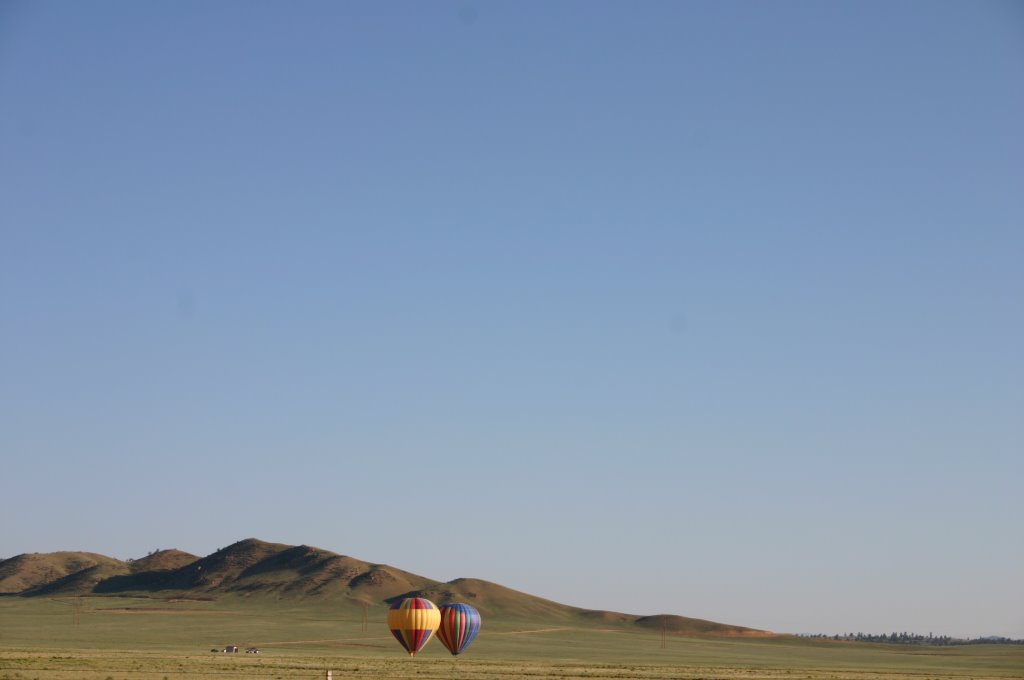
Your morning drive includes scenes like this.
(Taken just after sunrise Saturday in South Park )
When lightning strikes

(photo of lightning strike near Boulder by Commander John Bortniak, NOAA Corps, retired)
Four hikers were struck by lightning as they huddled beneath a tree during a thunderstorm Monday, including a 16-year-old who was resuscitated twice by CPR.
For tips on what to do when lightning is anywhere near you - within a few miles - check out the Colorado Lightning Resource Page by the National Weather Service or the Colorado Division of Emergency Management site.
Carbondale Fire Chief Ron Leach said the 16-year-old was suffering from numbness and tingling and was transported to a hospital in Glenwood Springs. A 22-year-old woman suffered burns on both legs, while the strike left another man’s face bloodied and another person with minor injuries, The Aspen Times reported. Reports said the four were in the Silver Creek area of Lead King Basin, about 4 miles north of Marble.
l'Alpe d'Huez ride today!

Think of l'Alpe d'Huez like the Tour de France's version of The Incline: a road through the Alps that climbs over 3,500 vertical feet through 21 switchbacks and can either demolish riders or propel them to victory.
This is the one day of the Tour de France I never miss: exciting, gut-wrenching, and guaranteed to bring out the best quirky phrases of federating cycling commentator Phil "Two titans dancing on the pedals" Liggett.
I'm willing to even stick my neck out and say this spot was host to one of the greatest moments in sports of all time, a moment cycling fans simply know as "The Look."
Here's a breakdown of it from USA TODAY:
It came in the 10th stage of the 2001 Tour, with Lance Armstrong and German rider Jan
Ullrich battling in the Alps in the first mountain stage.Knowing that the other teams closely monitored the Tour TV coverage for race intelligence, Armstrong pretended to be suffering early in the 120-mile stage. He stayed close to the lead pack as it rode the first two peaks, but he showed a pained look on his face.
Ullrich's team pushed the pace to wear out the seemingly forlorn Texan drafting on their wheels, saving his energy.
Their worst fears were soon realized when Armstrong teammate Jose Luis Rubiera pulled to the front and promptly accelerated, taking Ullrich, Armstrong and Andrei Kivilev with him.And then came The Look.
As the road began a steep rise toward the 21 switchback turns on the monstrous ascent of L'Alpe
d'Huez, the rivals were no more than a half-wheel apart after two earlier climbs and hours in the saddle. Suddenly, Armstrong accelerated, opening a gap of about 10 yards.Out of the saddle, his toes pointed down as he danced on the pedals, Armstrong suddenly slowed and looked over his left shoulder, his eyes fixed on Ullrich's face for four or five seconds, seemingly challenging his chief rival to match the bold move. The German rider's eyes were shielded by sunglasses, but everything else about his expression showed despair. He jerked at his radio earpiece and grimaced as Armstrong lit the afterburners, roaring alone toward the peak.
Eight miles later, Armstrong had gained two huge minutes on the 1997 champion, sealing his third Tour victory before the three-week race was half over.
Monday, July 17, 2006
Trail fee: $100. Freedom of the hills: priceless

It had to happen sooner or later.
The standard route up Wilson Peak, a fourteener near Telluride, crosses private land.
Property owners decided last year that they no longer wanted people crossing the property.
Now they appear to have changed their minds. Climbers can log on to www.wilsonpeakaccess.com and sign a liability waiver to legally enter the popular Silver Pick trail to the top of the peak.
Just one catch, they also have to pay $100 each via Paypal.
Sounds like most people are, instead, taking the longer, free route to the top via Navajo Basin.
Hardrock 100

(photo of previous Hardrock courtesy of trailhead.org)
Karl Meltzer won the Hardrock 100 on Saturday - and waited hours for the nearest competitor to cross the finish line.
From The Durango Herald:
SILVERTON -- Karl Meltzer had just run 100 miles and was into his third beer and lounging on a couch while he waited to see the second-place finisher kiss the rock marking the end of the Hardrock 100 ultramarathon.
Three and a half hours after Meltzer finished, someone finally caught up.
Meltzer, 38, extended his domination of the Hardrock 100 on Saturday, winning the 100-mile foot race for a record fourth time. He now owns the four fastest times in the race’s 13-year history.
“This is kind of my baby,” he said.
Beginning in Silverton at 6 a.m. Friday, Meltzer and 130 other extreme athletes ran to Telluride, Ouray and Lake City before circling back to Silverton. Through a hot day, a cold night and a beautiful sunrise, Meltzer ran despite the back pain, leg pain and foot pain that comes with running 100 miles. Water and power gels were his primary nourishment.
The Hardrock 100, as Meltzer said, “is the hardest 100 in the world.” The race is for people who think of a 26.2-mile marathon as a nice jaunt or for whom the sunrise is “a nice boost,” as another runner put it after running all night.
The course through the San Juan Mountains hits its highest point at Handies Peak, elevation 14,048 feet, and never dips below 7,700 feet elevation.
Finishing second was Joseph Shults of Ophir. A physician’s assistant from Steamboat Springs, Betsy Kalmeyer, came in third.
Kalmeyer set the women’s course record in 2001 with a time of 29 hours, 58 minutes. This year’s race took her nearly 32 hours.
Meltzer finished in 27 hours, seven minutes, the second-best time the course has ever seen, behind his 2001 mark of 26 hours, 39 minutes.
Sunday, July 16, 2006
Mr. Ranger, Sir...
From The Associated Press -- Wildlife agents are looking for a bear who injured a camper on the Grand Mesa near Powderhorn Resort
''It wasn't that the bear attacked her,'' said Randy Hampton, spokesman for the Colorado Division of Wildlife. ''The bear came into her tent, and when she surprised him, he took a swipe at her.''
The woman, whose name was not released, yelled at the bear and it fled Saturday morning. Hampton said the woman required 12 stitches to her right thigh at St. Mary's Hospital. If caught, the bear will be killed.
''Bears that show aggression toward people are put down. That's the policy of the Division of Wildlife,'' Hampton said.
(From: The Daily Sentinel)
''It wasn't that the bear attacked her,'' said Randy Hampton, spokesman for the Colorado Division of Wildlife. ''The bear came into her tent, and when she surprised him, he took a swipe at her.''
The woman, whose name was not released, yelled at the bear and it fled Saturday morning. Hampton said the woman required 12 stitches to her right thigh at St. Mary's Hospital. If caught, the bear will be killed.
''Bears that show aggression toward people are put down. That's the policy of the Division of Wildlife,'' Hampton said.
(From: The Daily Sentinel)
Saturday, July 15, 2006
Skateboarding is NOT a crime
My mom is visiting, so I had to beg out of driving to Denver to see even a sliver of the Dew Action Sports tour stop. She says spent enough time hanging out at skateparks and motocross tracks when my brother, sister and I were kids.
So I said "heck yeah," when this teenager I know, Eli Epstein, said he'd send a report from Pepsi Center. Eli's an eighth-grader at Manitou Springs Middle School. I didn't have to worry he'd blow me off, either - he's the son of Gazette A&E Editor Warren Epstein, and Warren wouldn't do us wrong.
Here's Eli's report from Denver:
"I'm sitting in the bleachers of the Pepsi Center watching 8-year-old kids fly high over my head on their skateboards. These kids are skating on a vert ramp that seems about 20 times their size.
Skateboarding has come so far in the past few years. This Dew Action Sports Tour is like a giant carnival of everything related to skating, BMX, FMX and being a teenager. You walk through this "festival village" outside the Pepsi Center and you run into tons of people eager to give you as much free stuff from their companies as possible. They were handing out Dew samples, batteries, skate DVDs and had a bunch of sweepstakes to win boards, bikes and trips to L.A.
The competition really heats up when we step into the bleachers. Eleven-year-old Nyjah Huston is beating some of the most famous skateboard legends, like Eric Koston. Every trick he does, he gives it his all and makes it perfectly clean. When he flip tricks up and grinds down the hubba, his dreadlocks flying behind him, he really gets the crowds' hearts pumping.
With the wonderful 30 Seconds to Mars concert at the end Friday, the Dew Action Sports Tour stop, which continues until Sunday, is really great.
My friends and I who skate seem to spend a lot of time getting kicked out of all the great local skate spots. Maybe this kind of event will show adults that skateboarding isn't a crime. It's a real sport, just like any other."
Well said, Eli. Keep skating (just don't grind on the railing down to my backyard). And keep an eye on Nyjah. Who knows what he'll do when he turns 12.
So I said "heck yeah," when this teenager I know, Eli Epstein, said he'd send a report from Pepsi Center. Eli's an eighth-grader at Manitou Springs Middle School. I didn't have to worry he'd blow me off, either - he's the son of Gazette A&E Editor Warren Epstein, and Warren wouldn't do us wrong.
Here's Eli's report from Denver:
"I'm sitting in the bleachers of the Pepsi Center watching 8-year-old kids fly high over my head on their skateboards. These kids are skating on a vert ramp that seems about 20 times their size.
Skateboarding has come so far in the past few years. This Dew Action Sports Tour is like a giant carnival of everything related to skating, BMX, FMX and being a teenager. You walk through this "festival village" outside the Pepsi Center and you run into tons of people eager to give you as much free stuff from their companies as possible. They were handing out Dew samples, batteries, skate DVDs and had a bunch of sweepstakes to win boards, bikes and trips to L.A.
The competition really heats up when we step into the bleachers. Eleven-year-old Nyjah Huston is beating some of the most famous skateboard legends, like Eric Koston. Every trick he does, he gives it his all and makes it perfectly clean. When he flip tricks up and grinds down the hubba, his dreadlocks flying behind him, he really gets the crowds' hearts pumping.
With the wonderful 30 Seconds to Mars concert at the end Friday, the Dew Action Sports Tour stop, which continues until Sunday, is really great.
My friends and I who skate seem to spend a lot of time getting kicked out of all the great local skate spots. Maybe this kind of event will show adults that skateboarding isn't a crime. It's a real sport, just like any other."
Well said, Eli. Keep skating (just don't grind on the railing down to my backyard). And keep an eye on Nyjah. Who knows what he'll do when he turns 12.
Friday, July 14, 2006
Wolf Creek road gets OK
From The Associated Press:
The Forest Service again endorsed road construction at the Wolf Creek ski area today, rejecting appeals by both sides in a heated debate over a massive development planned at the rustic Colorado resort.
The agency had earlier approved construction of two short roads for access to the proposed Village at Wolf Creek.
Three separate appeals by opponents said the Forest Service underestimated the impact of the project on the area and said the agency was improperly influenced by the development team working for Texas billionaire Billy Joe “Red” McCombs, a co-founder of Clear Channel Communications.
The developers, meanwhile, said the decision unfairly requires them to build a 750-foot road at cost of about $12 million, when a shorter extension of an existing road would be cheaper and have less environmental impact.
The Forest Service again endorsed road construction at the Wolf Creek ski area today, rejecting appeals by both sides in a heated debate over a massive development planned at the rustic Colorado resort.
The agency had earlier approved construction of two short roads for access to the proposed Village at Wolf Creek.
Three separate appeals by opponents said the Forest Service underestimated the impact of the project on the area and said the agency was improperly influenced by the development team working for Texas billionaire Billy Joe “Red” McCombs, a co-founder of Clear Channel Communications.
The developers, meanwhile, said the decision unfairly requires them to build a 750-foot road at cost of about $12 million, when a shorter extension of an existing road would be cheaper and have less environmental impact.
The things they carry... on fourteeners
A note I just got from a reader...

I enjoyed your article on Fourteeners but you failed to list an important item in your packing list. People should take ski goggles. A group of us hiked Mt. Massive in mid-September and as we climbed the wind started to blow hard and further up it started to snow "snow pellets." Before the hike my friend told me not to forget my goggles and I didn't. If I didn't have my ski goggles I would have had to return to the base. -- Jim Kennedy
Thanks Jim, can I use the lab goggles I still have from 8th-grade chemistry?
I enjoyed your article on Fourteeners but you failed to list an important item in your packing list. People should take ski goggles. A group of us hiked Mt. Massive in mid-September and as we climbed the wind started to blow hard and further up it started to snow "snow pellets." Before the hike my friend told me not to forget my goggles and I didn't. If I didn't have my ski goggles I would have had to return to the base. -- Jim Kennedy
Thanks Jim, can I use the lab goggles I still have from 8th-grade chemistry?
Free Continental Divide, llamas not included

In 1978, Congress officially created the Continental Divide National Scenic Trail also known as the “King of Trails” -- a 3,100-mile backcountry path along the spine of the continent from Canada to Mexico.
Almost 30 years later, only approximately 70% of the trail exists, and many of those miles are in desperate need of repair.
So what do you do? Wait for Congress to fund a federal trail-building earmark? Yeah, right. The trail was built almost entirely by volunteers, and that's how it is going to be finished.
But that kind of work is not the order of this weekend's Continental Divide TrailFest in Buena Vista. This weekend is all about enjoying the trail.
The Continental Divide Trail Alliance has organized a massive, free festival with guided hikes will get people out to trails.
Sign up ends today. Click here to sign up!
Need help deciding whether to go, click here and feast your eyes on the available hikes.
Have you hugged a trail today?
TrailFest 2006 is tomorrow, and groups of hikers will spread across the mountains from a base camp in Buena Vista.
If you want to participate, don't delay. Most of the trips are full, but the deadline to get in on the action is 11 a.m. TODAY, according to the TrailFest site, www.cdtrail.org.
You can still hike, even if not on an organized trip, and chow down on pancakes, check out gear from outdoor suppliers and kick back to live music. TrailFest celebrates the Continental Divide Trail. Pancakes start flipping onto plates and groups hit the trails at 7 a.m., so tonight is not the time for a pub crawl.
Need info now? Call 1-888-909-CDTA (2382) or email Christine@cdtrail.org.
If you want to participate, don't delay. Most of the trips are full, but the deadline to get in on the action is 11 a.m. TODAY, according to the TrailFest site, www.cdtrail.org.
You can still hike, even if not on an organized trip, and chow down on pancakes, check out gear from outdoor suppliers and kick back to live music. TrailFest celebrates the Continental Divide Trail. Pancakes start flipping onto plates and groups hit the trails at 7 a.m., so tonight is not the time for a pub crawl.
Need info now? Call 1-888-909-CDTA (2382) or email Christine@cdtrail.org.
Thursday, July 13, 2006
Wolf Creek news expected
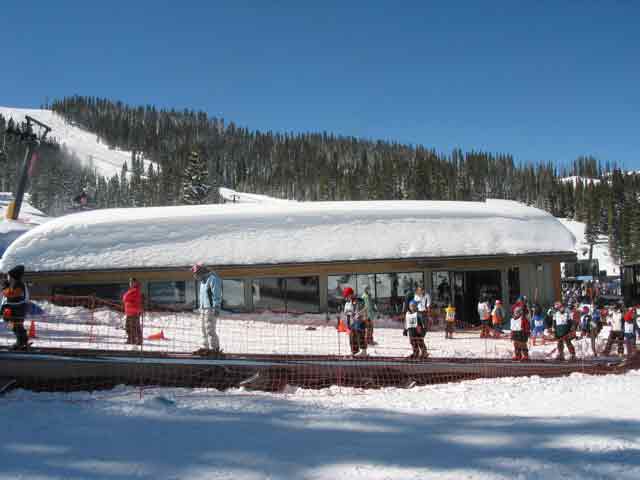
(Photo of Wolf Creek lodge by RH Pitcher)
From The Associated Press:
Regional Forester Rick Cables (U.S. Forest Service) will announce Friday whether he will reverse or modify a decision allowing new roads at Wolf Creek ski area. The proposed roads are a key step in plans for a massive development there.
In April, the agency approved the construction of two short roads in the Rio Grande National Forest for access to the proposed Village at Wolf Creek, which eventually could include 222,100 square feet of commercial space and housing for up to 10,500
people.
Both sides in the long-running battle appealed. Three separate appeals by opponents said the Forest Service greatly underestimated the impact of the project when it approved the roads and said the agency was improperly influenced by the developer.
The developers said the decision unfairly requires them to build a 750-foot road at cost of about $12 million, when a shorter extension of an existing road would be cheaper and have less environmental impact.
Opponents fear the development will hurt the environment and overtax schools and other services in tiny Mineral County, home to fewer than 1,000 full-time residents. Supporters say it will bring much-needed jobs and tax revenue to an economically depressed part of the state.
Sen. Ken Salazar, D-Colo., has asked the Agriculture Department, which oversees the Forest Service, to determine whether politics were behind the approval of the roads.
Changes at Dinosaur
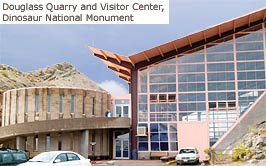 One of the most unusual visitor centers in the state has been closed indefinitely.
The Dinosaur National Monument Visitor Center that encloses an active fossil quarry has been deemed unsafe. The center, that surrounds a cliff embedded with dinosaurs, has been repaired repeatedly since it was built on clay in 1957. The center was a big draw for the national monument, offering a place where visitors could watch paleontologists work.
Local officials are worried the closure will affect tourism in the area. The massive park offers hiking, rafting and camping, but the center is its biggest draw.
Wednesday, July 12, 2006
1,000 km with 7 pounds of gear.
We blogged on the guys who were trying to do a 1,000 km unsupported traverse of the Arctic in Alaska when they started. They finished July 4. Here's their wrap up. It's worth reading, and checking out their site, if for no other reason than to appreciate how light they went. If you don't include the weight of food and water, they carried less than 7 pounds per person. Wow. I carry more than that on a day hike.
Bozeman, Mont. (July 7, 2006) - On July 4, a team of long distance trekkers completed the first and longest ever unsupported trekking traverse of America's most remote, roadless, uninhabited wilderness, a distance of 1000 km (600 mi) across Alaska's western Arctic region from the Chukchi Sea to the Alaskan Pipeline.
En route, in addition to completing America's longest wilderness traverse, the party became the first to visit the most remote location in the U.S. by fair means - carrying all of their gear, food, and supplies for the entirety of the trek in their backpacks and traveling entirely on foot.
"We crested the final hill, and there it was: the remotest place in America, situated in the mouth of a shallow draw, with a gravel band above, and a cluster of pretty mountains behind it, and a hundred-foot cliff bank below it. It was a beautiful scene." -- Expedition Member Roman Dial, from America's Remotest Spot on June 25, 2006
Their route traversed the most remote (westernmost) region of Alaska's Brooks Range, starting at the Chukchi Sea near the Native village of Kivalina and ending at the Alaskan Oil Pipeline Highway ("Haul Road") near Wiseman. This region is notable for two key characteristics: it is the largest contiguous roadless, uninhabited, and unprotected wilderness in America, and it contains America's remotest spot (defined by its distance from the nearest roads or habitations) in an area that is more than 15 times the area of the remotest spot in the contiguous U.S., which lies SE of Yellowstone National Park.
They faced tremendous challenges, including trekking up to 40 miles per day in the Alaskan bush and tundra, crossing the Brooks Range, swimming rivers swollen with snowmelt, standing down threatening grizzly bears, managing foot injuries, and trekking quickly to the end in the face of rapidly dwindling food supplies.
Early in the expedition, expedition member Ryan Jordan badly sprained an ankle, requiring the party to adjust their already precarious schedule, travel off their maps, and navigate to a safe location for a bush pilot to land. In another incident, they surprised a grizzly bear protecting a moose kill. On another day, they swam across one of the largest rivers in the Arctic. A few days later, they crossed the crest of the Brooks Range in a storm that threatened them with hypothermia.
The party completed the route in ultralight style, using fragile and lightweight gear considered absurdly inadequate by mainstream outdoor industry manufacturers. They slept under tarps made with the lightest racing sailcloth materials available, carried
backpacks that weighed only 24 ounces but carried 55-60 lbs (mostly food), and cooked over bush fires. They wore trail running shoes and carried no extra footwear. They traveled at night, and slept during the day - minimizing the amount of insulating gear they had to carry. The weight of their trekking gear, not including food and water, was less than 7 pounds per person.During the expedition, readers of the live satellite dispatches sent by the team to their web site, Arctic1000.com, expressed controversial opionions about the team's style and strategy, from their choice not to take guns for bear protection, to their use of a satellite phone to ensure safety in an emergency, to their use of running shoes as a means to trek through the Alaskan bush.
Expedition member Ryan Jordan, publisher of Backpacking Light Magazine and the BackpackingLight.com web site, says: "This expedition was ambitious. There was never a guaranteed outcome of success, even towards the end. It was a serious test of ultralight trekking technique and gear, athleticism, and sheer power of will. On a personal level, it was the most engaging strategy I've ever used to enjoy a wilderness traverse."
Tuesday, July 11, 2006
More on Pueblo

The most dedicated paddler in our newsroom, Andy Wineke, the TV Talk columnist, just sent me this pic from when he bagged work early yesterday and hit the Pueblo Park. Pretty Sweet.
Pueblo still running big
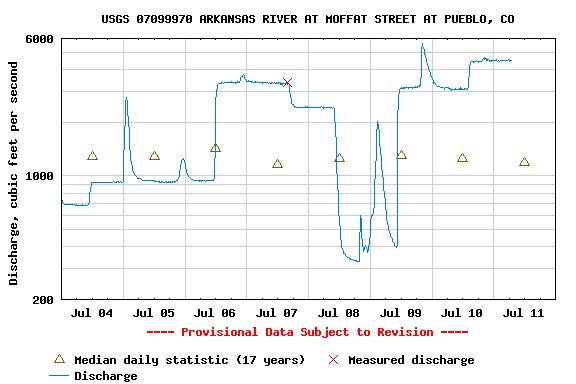

As I reported in The Gazette today, the Pueblo Whitewater Park is experiencing its biggest flows ever. Yesterday, locals weren't sure how long the high water, which has conjured up some huge waves, would last.
Checking the real time USGS gauge this morning, it's still gushing at 4,500 cfs, more than 10 times the flow it had just a few days ago.
When the water first crested, local paddlers told me they often had to dodge trash and large branches floating down the river, but now that the water has been up for a while, the creek is clear, and paddlers on mountainbuzz.com are singing the praises of the waters at flood stage.
Monday, July 10, 2006
Surprise Gold Camp Road decision
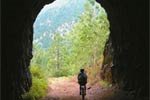
The debate over Gold Camp Road has gone on for years. Today, the years of discussions, public forums and Forest Service review effectively came to an end. A Forest Service review officer reversed a decision last year to allow the section of road between High Drive and Old Stage Road to reopen. There'll be no driving on that section of the road.
Pike National Forest supervisor Bob Leaverton had decided last year that the road could be reopened if private funding was raised. About $750,000 was needed to repair a collapsed tunnel on the road, that is a popular hiking, biking and motorcycling trail. For a previous story about the road, check out http://outdoors.coloradosprings.com/dirt/fullStory.jsp?id=2334
Walking for a cause
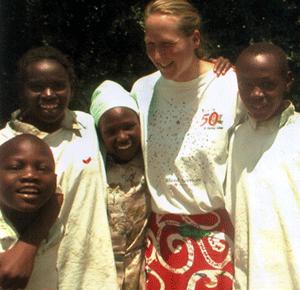 Debbie Schachner had thought about walking the American Discovery Trail ever since she read an article about it in Backpacker magazine. But the O'Fallon, Ill., resident wanted to do it when she had a reason. She went to Kenya, where she worked as a teacher. When she returned, she says, "I had a reason."
Schachner decided she should build a library in Kenya, so she set out to hike the ADT, collecting donations from individuals and groups along the way.
She's in Colorado this week - she leaves from Mueller State Park Tuesday morning, bound for Canon City and then Pueblo. She decided to hike the trail from west to east, the opposite of most ADT hikers.
She says her time on the trail has "shown me the goodness of people." Her worst experience: in Utah, when she walked two days in the wrong direction and fell in a stream and got stuck in quicksand. Her best experience: "The number of good and kind people I've met."
For more on Debbie, her cause and her walk, go to www.walkingwithfaith.com
Aspens in trouble?
 It's nearly impossible to imagine Colorado without its signature aspen trees. But stands of aspens are dying out throughout the state, and foresters are alarmed.
The most recent die-off: in the Dolores Ranger District's Turkey Knolls near Mancos. “I think we’re going to see huge changes in 30 to 40 years,” said Phil Kemp, forester with the Dolores Public Lands Center, in an AP story:
Kemp first noticed the change in aspen stands two to three years ago, but the first official report of dying aspens in Southwest Colorado came when the U.S. Forest Service’s forest health management group did an aerial survey of the area, marking the changes in aspen stands.
Dying aspens have been recorded in other states as well, but there is no apparent pattern, said Wayne Shepperd, research forester with the Forest Service’s Rocky Mountain Research Stationin Fort Collins. “It seems to be occurring at different places and to various degrees,” he said. “We have lots of questions, but no answers. We haven’t seen anything like this in Colorado before."
Kemp and the team of researchers have not been able to determine why the aspen stands are dying or why the mortality may be occurring at this point, but they suspect repeated years of drought, as well as insects and disease, may play a role. Without the needed moisture, aspens are weaker and less resistant to insects and disease.
This is from a story by Gazette writer Bill McKeown in March 2006:
Colorado’s shimmering stands of aspen trees, as potent a symbol of this state as its soaring peaks, are in danger of disappearing.
That’s the sobering conclusion of the Colorado State Forest Service’s recently released annual report on the health of the state’s forests. Colorado’s 4 million acres of aspens are reaching the end of their natural life cycle of about 120 years. But foresters already have seen troubling signs the trees may not regenerate themselves through their extensive system of roots and suckers, the author of the report, Jen Chase, said last week.
All over Colorado, aspens are being choked off by an invasion of conifers, a generic name for the cone-bearing evergreens that dominate the state’s forests. ... This cycle of birth, death and rebirth of aspens has occurred every century or so since the deciduous trees first sprouted in the moist glacial soils of the last Ice Age. But the coming cycle of dieoff lacks a crucial component of rebirth: fire. New life in the forests, experts say, requires the kind of fires that Coloradans have done their darnedest to prevent for a century. ...
Because fire has been suppressed for more than a century, vast swatches are now covered in tall, weedy conifers whose shade is blocking new aspens. ... Foresters ... say Colorado will inevitably lose some of its 4 million acres of aspens permanently. ... (and) favor prescribed burns of conifers to reduce fire danger, create clearings for aspens and create forests that contain trees of different ages. ... On a small scale, aspen stands can be rejuvenated by using machinery to slice through the extensive root system, spurring the production of new suckers. ... Whatever strategies are used, it will take many years, many dollars, a lot of hard work and the understanding of residents and environmentalists, the foresters say.
Summer luge
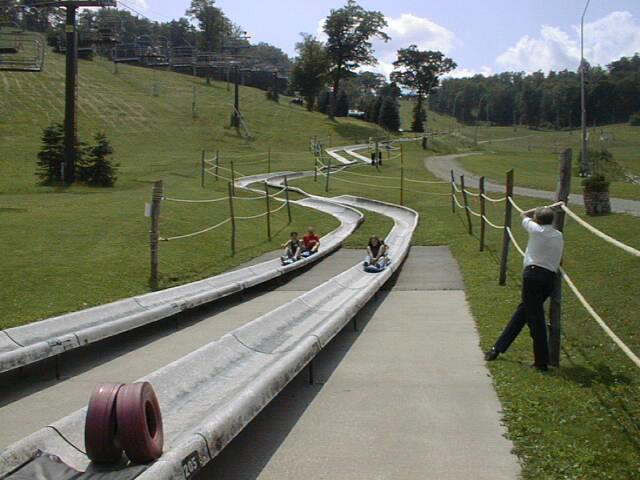
Some people just don't know how to have fun.
Homeowners near the Haymeadow ski run at Beaver Creek are fighting Vail Resorts' plans to install an alpine slide.
What's an alpine slide? It;s a sort of luge track you run on wheeled sleds when there's no snow.
Owners of expensive homes near Haymeadow say the track would change the character of the area.
“It’s not what people here want. I’d say at least 90 percent of the resort property owners are against it,” said Bernie Scharf,” president of the McCoy Peak Condominium Association and spokesman for several other associations in the Haymeadow area.
Vail Resorts has put off the project until least Jan. 31 while it looks at alternative sites, an official said.
Pike week begins

Today is the first day of what the Colorado Springs City Council has officially dubbed Pike Week in honor of the area's first Western explorer and first publicly confounded mountain climber.
The week is marked by a series of activities, including the displaying of items from a 1906 time capsule hidden under a Zeb Pike memorial downtown, and the display of some of his 200-year-old papers and journals he carried on his expedition.
For more info, click here.
Friday, July 07, 2006
Missing hiker found
Rescuers found a 57-year-old man who had been missing since Monday. The message to share: Kerry Garcia of Albuquerque was prepared with emergency gear and had left map coordinates of where he was preparing to go.
Garcia was suffering from exposure, sunburn and dehydration when he was found Thursday in a remote area in the Maroon Bells-Snowmass Wilderness, according to the AP. He was last seen Monday morning at the Avalanche Creek campground, sheriff's officials said.
Garcia, who was searching for hunting spots for a future trip, got stuck in the cliffs above a tributary of Avalanche Creek, where he could neither climb or go back down the way he came.
Again, the message to take home: He had emergency gear and searchers knew where to look for him because he'd shared that information.
Garcia was suffering from exposure, sunburn and dehydration when he was found Thursday in a remote area in the Maroon Bells-Snowmass Wilderness, according to the AP. He was last seen Monday morning at the Avalanche Creek campground, sheriff's officials said.
Garcia, who was searching for hunting spots for a future trip, got stuck in the cliffs above a tributary of Avalanche Creek, where he could neither climb or go back down the way he came.
Again, the message to take home: He had emergency gear and searchers knew where to look for him because he'd shared that information.
Family in the forest
Some 15,000 members of the Rainbow Family who spent up to a week camping in the woods near Steamboat Springs left a big imprint on the land, the Forest Service said today.
Aerial photographs show the campers carved 40-50 miles of trails in the woods and a nearby meadow in Routt National Forest, said Forest Service spokeswoman Denise Ottaviano, noting that any gathering that size will have consequences.
Rainbow Family representatives said members will stay behind after the bulk of the group leaves to tend to the forest and minimize the group's impact on wildlands and wildlife. Forest officials are expected to oversee the work.
Officials estimate about 7,500 Rainbow Family members remain at the site.
Aerial photographs show the campers carved 40-50 miles of trails in the woods and a nearby meadow in Routt National Forest, said Forest Service spokeswoman Denise Ottaviano, noting that any gathering that size will have consequences.
Rainbow Family representatives said members will stay behind after the bulk of the group leaves to tend to the forest and minimize the group's impact on wildlands and wildlife. Forest officials are expected to oversee the work.
Officials estimate about 7,500 Rainbow Family members remain at the site.
Can you light a campfire?
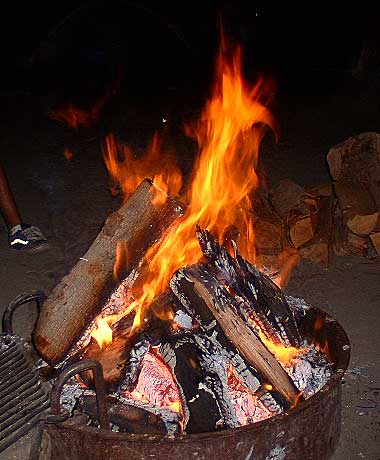
If you're headed out camping this weekend, make sure you check for fire restrictions.
Some Colorado counties are easing fire restrictions, with federal officials lifting their ban on 3 million acres of land across southern Colorado, including the
Pike-San Isabel National Forest.
But Arapahoe and Summit counties kept limits in place. Officials say they’re worried about future dry spells.
“We have a checklist to determine if we meet the criteria for lifting the restrictions,” U.S. Forest Service spokeswoman Barb Timock said. Restrictions could be reimposed if the weather dries out.
Park County lifted all restrictions, while Jefferson and Douglas counties, eased theirs.
Wet weather is expected to continue through next week, National Weather Service meteorologist Jim Kalina said, but summer monsoon season often is followed by dry spells.
Statewide fire restrictions:
A closer look at Blodgett Peak Open Space
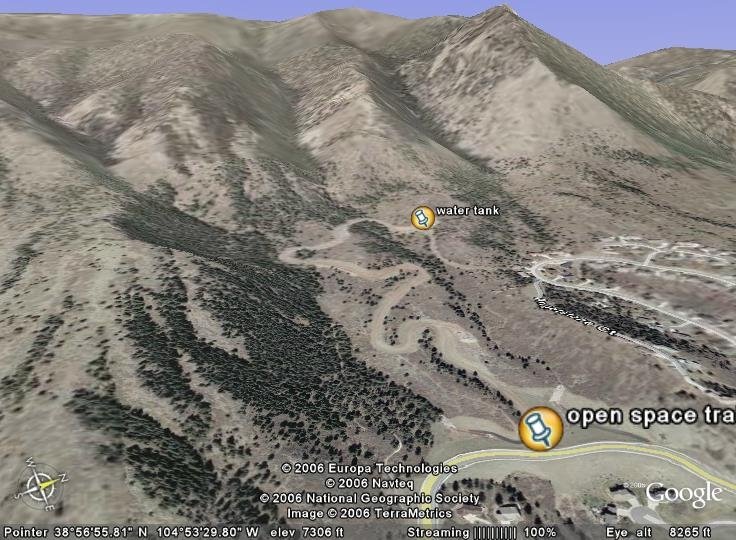
Here's a bird's eye view of Blodgett Peak Open Space, courtesy of GoogleEarth. Click the picture for a larger image.
Not a good week for teens in the mountains

This weekend, we ran a story about two teenage boys from Texas getting hit by lightning while climbing the Spanish Peaks. Yesterday, two Boulder boys had to be rescued after they decided to slide down Arapaho Glacier in the Indian Peaks. One broke his leg. Another hit his head severely. Apparently the trip down the snow field was faster than they planned.
What a beautiful thing to have such a big, wild, dangerous place as the Rockies to be young in.
This week's happy trail: Blodgett Peak Open Space

Ahhh... beautiful Blodgett. We'll have more photos of the hiking here as soon as Deb Acord rolls into the newsroom (hey, give her a break, it's Friday). Until then, thanks to summitpost.com for this photo.
If you didn't see Out There, read today's Happy Trails description.
When you ski off a cliff, who do you sue?

photo from skigb.com
The AP reported today the case against Vail Resorts brought by a family of a man who died of head injuries while skiing at Breckenridge will go to the court of appeals.
(NO, that is not a photo of the incident; just a cool, obviously off-trail ski photo.)
At issue is whether the area where he was skiing was actually skiable, or whether his death was due to negligence in design and maintenance of its area, and of failing to mark a cliff.
Basically, the family is suing because the run was too hard.
Normally, as I understand it, the Colorado Skier Protection Act (created to protect ski areas, not skiers) absolves the resort from any liability for skier injury unless it was caused by a man-made object.
For example. If a ski patroller had parked a snow mobile in the middle of the slope, and a skier ran into it, the skier could probably recover damages. But if the skier hits a tree, he's out of luck.
In this case, the skier apparently was skiing off the trail when he hit something (sorry can't find info about exactly where he was) and the family's lawyer is arguing that since he was off the trail, the Colorado Skier Protection Act doesn't apply.
Should be interesting.
Let's hope this doesn't affect whether we're allowed to ski off-trail in the future. That's where the good snow is.
Thursday, July 06, 2006
Storm's a comin'

It was, indeed, the calm before the storm... The scene from my Manitou Springs balcony, looking west, before the last deluge.
Send your storm photos to dave.philipps@gazette.com, and we'll share them here.
Bear vs. woman
Fortunately, momma bear was being protective and not predatory...
From the AP
A Hawaii woman was being treated in a Seattle hospital today after she was mauled by a brown bear in Southeast Alaska.
Ann Scheller, 57, suffered head, neck and leg wounds in the attack Sunday in Berg Bay, about 20 miles east of Wrangell. Scheller said she was briefly separated from two hikers on a trail when she got between the female bear and its cubs. The bears left the area after the mauling.
“I was in the wrong place at the wrong time,” Scheller said in a telephone interview with the Honolulu Star-Bulletin. “She sent out the warnings and I was just trying to move on.”
Scheller, an emergency room nurse, told the newspaper she was discovered by her friends about an hour after the attack. She was in satisfactory condition, a hospital spokeswoman said.
From the AP
A Hawaii woman was being treated in a Seattle hospital today after she was mauled by a brown bear in Southeast Alaska.
Ann Scheller, 57, suffered head, neck and leg wounds in the attack Sunday in Berg Bay, about 20 miles east of Wrangell. Scheller said she was briefly separated from two hikers on a trail when she got between the female bear and its cubs. The bears left the area after the mauling.
“I was in the wrong place at the wrong time,” Scheller said in a telephone interview with the Honolulu Star-Bulletin. “She sent out the warnings and I was just trying to move on.”
Scheller, an emergency room nurse, told the newspaper she was discovered by her friends about an hour after the attack. She was in satisfactory condition, a hospital spokeswoman said.
Did you hear the one about...
 (Finishing the Leadville race)
...the guy who has pledged to run 50 marathons in 50 days?
Samuel Thompson, 25, of Mississippi, is running to raise awareness of the Gulf Coast's recovery from Hurricane Katrina. Thompson started his epic run at a marathon in Leadville on July 1, followed by races in Casper, Wyo., Bozeman, Mont., Sauvie Island., Ore., and Salt Lake City.
Samuel Thompson, 25, of Mississippi, is running to raise awareness of the Gulf Coast's recovery from Hurricane Katrina. Thompson started his epic run at a marathon in Leadville on July 1, followed by races in Casper, Wyo., Bozeman, Mont., Sauvie Island., Ore., and Salt Lake City.
Tomorrow, he's in Reno, Nev., and plans to wrap up Aug. 19 in Bay St. Louis, Miss., where he has been doing volunteer work at a Katrina recovery center. If a state doesn't have a planned marathon, Thompson will do a marathon-length run there anyway. He has a good chance of reaching his goal. He has run 40 marathons since he was 18, and two years ago, he ran the length of the Appalachian Trail.
Check out his blog at www.50in50in50.com
Cautionary tale
 (It's important that everyone on a group trip know of any one person's allergies and what to do in case of emergency. Thanks, Morgan, for sharing your story.)
 The list of things that cause 10-year-old Morgan Smith of Colorado Springs to have an allergic reaction is a long one: peanuts, soybeans, peas, eggs, cats, dogs. But until a recent camping trip, Morgan's list didn't include trout. Here's his story of a scary night in the woods that turned out all right.
A Story of Anaphylactic Shock
Two hundred miles from home and while camping at 10,000 feet in the Rocky Mountains I wasn’t supposed to be allergic to fish. But now I think I am after that night camping in the Uncompahgre National Forest.
We had caught 3 wild trout earlier that day down at Lake San Crystobal and had a lot of fun. My dad cleaned the fish while there so we only had to cook them when we got back to camp. When we did get back to camp, we decided to sauté them in butter and lemon juice after we steamed them. My dad let me and my sister, Michaela, sample the seasoning so we knew that we liked it. That was about 20 minutes before I even ate. My dad also cooked some shell pasta that evening also with the trout.
Dad handed me a large piece of trout and a bowl of shells, both of which had the seasoning on them. “Try a piece of fish. Is it good?” my dad asked. I tried a piece. “This is great Dad! Thanks for cooking this.” I replied.
We had started a fire right as we got back from the fishing. Only a few minutes after I had taken a bite, my gums started to itch some. I started to space out and stare into the coals of the fire. “Morgan, what’s wrong? Talk to us, come on talk to us.” My dad said, awakening me back to earth.
“Ev-Everything’s all right except my gums itch.” I stuttered back.“Get the Benadryl, Michaela!” my dad shouted. Michaela raced into the tent. “Where’s the Epi kit?” my sister asked. “It’s on my mattress!” I yelled back. My gums started to itch a lot more. My sister raced back out and gave my dad a Benadryl. He gave it to me. About a minute later, my gums didn’t itch as much. I had a few more shells, but no more trout. My chest started to hurt a little. I couldn’t breathe as well. I started to space off again and again, staring at the coals.
“Morgan, talk to us! What’s wrong? Morgan!” my dad said. “My chest hurts a little. I’m having a little trouble breathing. Grab the Epi Pen!” I said yelling at the end of my sentence. Michaela grabbed the Epi Pen out of my epi-kit. She gave it to dad and dad sat right next to me. He gave me some breathing exercises. On my last exercise, my breathing started to be really shallow. I couldn’t breathe a lot.
“Dad, give me the Epi Pen!” I croaked. Dad jammed it into my left thigh, and counted to ten. Dang! Dang this hurts! I thought. He let it out. “Michaela, put out the fire, we’re leaving.” Michaela put out the fire.
I know what you’re thinking as you read this. Didn’t you call 911 right after you inject it? We couldn’t. We were at 10,000 feet in elevation with trees surrounding us, so Dad had no cell service. We climbed into the car. I burped. “I feel like I’m going to throw up, Dad.” Dad opened the door, and I climbed out. I threw up. I knew this would happen, because whenever you body rejects something it doesn’t like, you throw it back up. After about half a minute, we climbed back into the car. My dad gave me a bag, in case if I had to throw up anymore.
We were almost at the very top of a rock 4WD trail, but my dad went over the rocks. He flashed his lights and honked his horn.Cars got out of his way.Michaela, in the back seat, kept talking to me about things. My legs we very jittery from all the adrenaline put into me from the Epi Pen. We saw red lights ahead on a type of fire truck. My dad stopped. So did the man in the truck with the flashing lights. My dad backed up. He said, “I have a son in anaphylactic shock, and I need to get him to the ER right now!” “Where is he?” the man asked.“In the back seat with me,” Dad replied. “Can you radio into the ER in Lake City to tell them we’re coming?” “Sure.”“Thanks a lot!” my Dad replied, and drove off down the road.
We came to where the gravel road met the pavement. A police car pulled out behind us. My dad rolled down his window. He waved them by. The police car came up next to us and one of the police men yelled, “Follow us!” My dad nodded back. The police car zoomed down the road toward Lake City, the nearest town. We were going about 65 mph on the road. The police car pulled over in a little circle, where an ambulance was waiting. We all opened our doors at once. I was helped out.
I limped along, because my left thigh was sore from the injection of the Epi Pen. The paramedic asked questions, and my sister answered them. He had his cut kit out ready to perform a tracheotomy on me, but I didn’t need that. My breathing was fine. He closed the doors, and the ambulance took off, my dad in his car, and the police car lights and sirens following me in the ambulance. The paramedic asked me many questions to keep me from spacing off. We got to the medical center. The doctor and nurse helped me in to the emergency room, and took my heart rate, blood pressure, and my pulse oximetry. My legs were starting to calm down. They gave me some water to drink and asked some questions like: how old are you, when did you use the Epi Pen, what medications do you take, and how do you think this happened? I answered all of them.
My dad called Mom who was back at home, and Mom was scared. I started to feel better. I got up, and went into the lobby for a little while and watched some TV. They wanted to keep me for a little while, so they could watch how I was doing. We bought another Epi Pen, and they prescribed me Prednisone. We left the medical center about 2 ½ hours later. I was very tired. We went back to camp, and I went to bed. My dad stayed up until 3:00 a.m., just to make sure I wasn’t having another shock or reaction.
I’ve been fine ever since, and we stayed up camping for another 2 days. During this incident, I was very scared of what would happen to me. I didn’t believe that the Epi Pen would really work, but it definitely did! If this were to ever happen again, I’d know what it would feel like. I wouldn’t be scared to have a shot because not being able to breathe hurts a lot more. Now I know not to eat fish, and especially trout. Even one bite can do a lot of things to your life.
Beware the gathering clouds
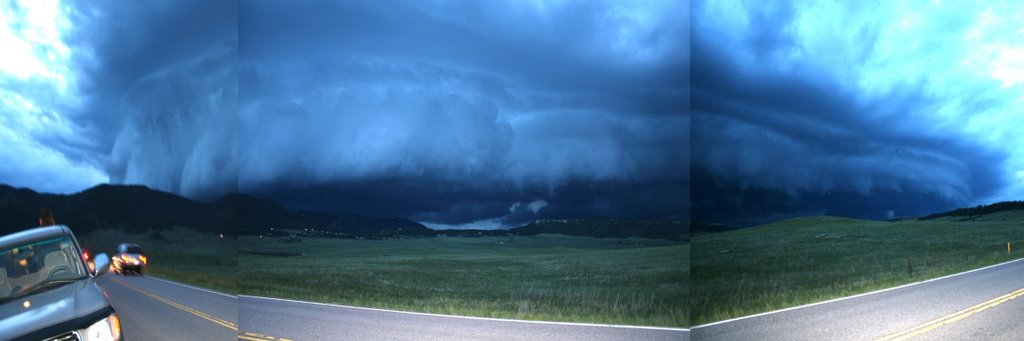
Bart Phillips of Monument sent us this photo of an awesome storm cell that blew into Palmer Lake around 9 p.m. on July 4. He was standing on Highway 105 looking north. Bart says the Palmer Lake fireworks show was started 30 minutes early (at 9) to prevent a rain-out. What a backdrop!
Thanks, Bart.
Anyone else have a great shot to share? If not, keep your cameras handy. Looks like Mother Nature has more in store for us. Send your photos to dave.philipps@gazette.com.
Send me your storm photos

Flash flood warnings, rain that just goes on and on, creeks jumping their banks. I'm sure with all this water people have good flood photos from last night. E-mail them to me (dave.philipps@gazette.com) and we'll run a greatest hits blog.
A lighter side of fourteeners, figuratively, clearly not literally
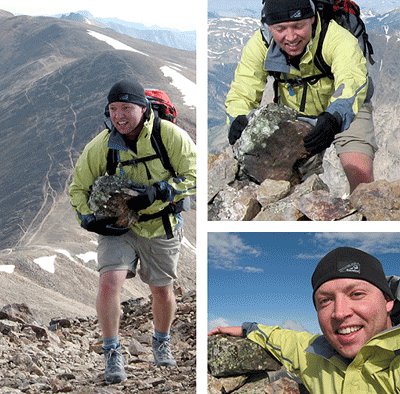
This is pretty funny. In a post on www.14ers.com, this guy has pictures of himself tossing a large rock off of 14,001-foot Sunlight Peak, relegating it to the status of "thirteener." Now, in a new post another climber has taken a large rock and lugged it back up to restore the mountain's "dignity."
And of course, this got other climbers on the thread talking about whether they could move a bunch of rocks on some high thirteeners, to make them fourteeners.
Not sure the USGS would go for that.
Wednesday, July 05, 2006
Little Bear death confirmed

Mathew Zimmer, 38, of Wichita, Kansas, was climbing with two friends when he fell about 350 feet to his death on Little Bear Peak on Sunday, according to the coroner's office in Alamosa. His route basically went up the steep face in the middle of the above photo
Two dead in the Sangres, another almost dead in Spanish Peaks

This isn't confirmed yet, but it's creating a buzz on 14ers.com
A man died Sunday while climbing the Northwest Face of Little Bear Peak in the Sangre de Cristo Mountains.
This is a VERY exposed, 4th Class route where one mistake could be your last. Apparently, a rock he was on slipped and he fell.
Reports say another climber died on Pico Asilado, a thriteener in the Sangres, this weekend.
Finally, two teens from Texas were hit by lightning over the weekend while climbing one of the Spanish Peaks.
The Associated Press reported that one teen's heart stopped beating and the other had to perform CPR to revive him.
Fourth of July is typically the start of the summer climbing season in the high peaks. But that doesn't mean these peaks are easy or particularly safe. Be careful. Be cautious. Go with someone who has experience, and remember experience is not a talisman.
Monday, July 03, 2006
The other side of the rainbow
It calls itself a nonorganization with nonmembers, and among its tenents is taking care of the Earth. The Rainbow Family, gathering this week in the Routt National Forest 30 miles from Steamboat Springs, will have a lot of caring to do when its crowd of 10,000 to 20,000 leaves.
The family descends upon a national forest once a year. Campers are in a drought-parched area of the Routt forest, and officials say the forest has been "tremendously impacted" by the family members who dug group latrines and fire pits and made informal trails and paths.
The family says it always leaves some members behind to reseed damaged areas, cover fire pits and remove bridges over streams. Forest officials say they will make sure they follow through.
The family descends upon a national forest once a year. Campers are in a drought-parched area of the Routt forest, and officials say the forest has been "tremendously impacted" by the family members who dug group latrines and fire pits and made informal trails and paths.
The family says it always leaves some members behind to reseed damaged areas, cover fire pits and remove bridges over streams. Forest officials say they will make sure they follow through.
The best Colorado Webcams?
The site www.jonmck.com/coloradowebcams/
claims to have the greatest hits of Colorado Webcams.
I'm not so sure. After all, it doesn't include the Cheyenne Mountain Zoo's Giraffe Cam or the Xcel falcon cam.
Any other good cams out there I'm missing? Post your suggestion below.
claims to have the greatest hits of Colorado Webcams.
I'm not so sure. After all, it doesn't include the Cheyenne Mountain Zoo's Giraffe Cam or the Xcel falcon cam.
Any other good cams out there I'm missing? Post your suggestion below.
No glory, just guts
The top 40 teams have crossed the finish line at the 417-mile Primal Quest adventure race. Several others have dropped out or lost a team member so they no longer qualify in the official rankings. But 18 teams are still churning their way toward the finish, tired, probably very blistered, and with no pay off other than being able to say they did it. They've now been going for nine days. They have until tomorrow to reach the end. One wonders how a racer could willingly suffer for so long. I watched the leaders go through some pretty nasty ordeals, but at least they had a cash prize driving them on.
Saturday, July 01, 2006
5 teams in
It'll be a while until the next team hits the finish line, but five teams are in and the adjusted times are posted on the Primal Quest Web site, www.ecoprimalquest.com, and below:
Nike PowerBlast 5:45 a.m.
GoLite/Timberland 6:06 a.m.
Merrell/Wigwam Adventure 12:32 p.m.
Supplierpipeline 12:43 p.m.
Salomon/Crested Butte 1:24 p.m.
Bjurfors Adventure Racing, SOLE and Orionhealth.com are through checkpoint 40, and should be in the thick of their mountain trek in the La Sals.
It's drizzly here in Manitou Springs. I hope it's at least a bit cooler than the past few days in Utah.
Nike PowerBlast 5:45 a.m.
GoLite/Timberland 6:06 a.m.
Merrell/Wigwam Adventure 12:32 p.m.
Supplierpipeline 12:43 p.m.
Salomon/Crested Butte 1:24 p.m.
Bjurfors Adventure Racing, SOLE and Orionhealth.com are through checkpoint 40, and should be in the thick of their mountain trek in the La Sals.
It's drizzly here in Manitou Springs. I hope it's at least a bit cooler than the past few days in Utah.
First teams cross finishline in Primal Quest
After five days, the first and second places in the 417-mile Primal Quest adventure race were decided by less than 45 minutes at dawn this morning.
The favorite, team Nike, which is made up of racers from Boulder, Vail, and Summit County, came in first after leading the pack for much of the race. GoLite, a team plagued by problems the whole race, powered through their setback for an amazing second-place finish. Team Merrell/Wigwam has not crossed the finish yet, but is in place to finish third. Colorado team Salomon/Crested Butte is in position to take 5th, a huge victory for them; they placed 10th in the last Primal Quest and have been sitting around 15th for most of the race. They told me at the start that they would play conservative and make their move in the mountains near the end. I guess they meant it.
Colorado team Spyder, is in 9th place right now, plagued by fatigue and bad feet.
We'll see if there are any last-minute surprises in the top ten as they roll in this morning.
The favorite, team Nike, which is made up of racers from Boulder, Vail, and Summit County, came in first after leading the pack for much of the race. GoLite, a team plagued by problems the whole race, powered through their setback for an amazing second-place finish. Team Merrell/Wigwam has not crossed the finish yet, but is in place to finish third. Colorado team Salomon/Crested Butte is in position to take 5th, a huge victory for them; they placed 10th in the last Primal Quest and have been sitting around 15th for most of the race. They told me at the start that they would play conservative and make their move in the mountains near the end. I guess they meant it.
Colorado team Spyder, is in 9th place right now, plagued by fatigue and bad feet.
We'll see if there are any last-minute surprises in the top ten as they roll in this morning.
Neck and neck
After five days of racing across desert, rock, mountains, forests, and sheer cliffs, less than 45 minutes separated the top two teams in Primal Quest, the 417-mile race, set this year near Moab, Utah.
Nike PowerBlast crossed the finish line at 5:45 a.m., race organizers said. Team Nike slept a total of 13 hours in their 143 hours of competition.
67 teams are still racing, with a handful expected to finish within hours.
An edited version of the finish-line update from the Primal Quest site, www.ecoprimalquest.com:
“It was more like adventure torture," Michael Tobin said, as Team GoLite/Timberland dogged Nike until the finish line, arriving less than 45 minutes behind.
“We had to persevere and push like no other,” said team captain, Michael Kloser, teammate Ian Adamson noted that it was an “amazing, amazing course.”
This year’s Primal Quest took athletes through many of Utah’s majestic landmarks including, Gemini Bridges, the slickrock of Moab and the towering rock spires of Castle Rock, the Rectory, and the Priest and Nuns. Teams ascended and rappelled over eight miles of rope during the race, a massive and record-breaking undertaking by race directors. Due to the harsh climate, 15,000 gallons of water and over 1,800 cases of Gatorade (more than the inventory supplied to the major college Bowl Games & Super Bowl combined) were placed at strategic water stations throughout the course.
Nike PowerBlast crossed the finish line at 5:45 a.m., race organizers said. Team Nike slept a total of 13 hours in their 143 hours of competition.
67 teams are still racing, with a handful expected to finish within hours.
An edited version of the finish-line update from the Primal Quest site, www.ecoprimalquest.com:
“It was more like adventure torture," Michael Tobin said, as Team GoLite/Timberland dogged Nike until the finish line, arriving less than 45 minutes behind.
“We had to persevere and push like no other,” said team captain, Michael Kloser, teammate Ian Adamson noted that it was an “amazing, amazing course.”
This year’s Primal Quest took athletes through many of Utah’s majestic landmarks including, Gemini Bridges, the slickrock of Moab and the towering rock spires of Castle Rock, the Rectory, and the Priest and Nuns. Teams ascended and rappelled over eight miles of rope during the race, a massive and record-breaking undertaking by race directors. Due to the harsh climate, 15,000 gallons of water and over 1,800 cases of Gatorade (more than the inventory supplied to the major college Bowl Games & Super Bowl combined) were placed at strategic water stations throughout the course.
PowerBlast did it
Nike PowerBlast is the winner of Primal Quest - Utah.
There's a photo on the PQ site (www.ecoprimalquest.com) of Rich Brazeau and race directors Dawn and Don Mann congratulating Nike PowerBlast on the win.
I'll post photos when I can get to the office, Check out the PQ site for great photos and video. We'll have a recap and scenes from the race course in The Gazette by reporter Dave Philipps and photographer David Bitton. We'll let you know the pub date here.
There's a photo on the PQ site (www.ecoprimalquest.com) of Rich Brazeau and race directors Dawn and Don Mann congratulating Nike PowerBlast on the win.
I'll post photos when I can get to the office, Check out the PQ site for great photos and video. We'll have a recap and scenes from the race course in The Gazette by reporter Dave Philipps and photographer David Bitton. We'll let you know the pub date here.
Do we really have a winner?
There are photos posted of Nike PowerBlast team members hugging at the finish line and a racer "describing his experience." I'm looking for official word of a handover of the big check.
Late race rally
Teams Merrell, Supplierpipeline and Salomon - Crested Butte picked up steam late Friday. They were running three to four checkpoints behind the leaders, according to the the online toteboard at Primal Quest's Web site, www.ecoprimalquest.com.
The teams are just one segment behind the leaders now. Only catastrophe could put them in the winner's circle, but it'll be interesting to hear how they summoned the energy and drive in the final hours to kick it up a notch after more than five days running, swimming, biking, paddling, climbing, horseriding and trekking.
--dena filing from manitou springs
The teams are just one segment behind the leaders now. Only catastrophe could put them in the winner's circle, but it'll be interesting to hear how they summoned the energy and drive in the final hours to kick it up a notch after more than five days running, swimming, biking, paddling, climbing, horseriding and trekking.
--dena filing from manitou springs
Down to the wire
Nike PowerBlast and GoLite were trying to outclimb one another in the wee hours of the morning when Primal Quest, the 417-mile adventure race nearing its finish in Utah, was stopped due to lightning. The teams restarted about 3:25 a.m. and we should hear soon who scrambled to the finish first.
This is the closest finish in PQ history.
The winning team gets $100,000.
--dena, filing from manitou springs
This is the closest finish in PQ history.
The winning team gets $100,000.
--dena, filing from manitou springs
Friday, June 30, 2006
Friend or foe of the forest?
If you've been following the news you know members of the Rainbow Family are gathering in the forest near Steamboat Springs - and getting cited for doing so.
The group has been meeting once a year for decades, but its decision to meet in the tinder-dry Routt National Forest didn't sit well with forest officials.
The U.S. Forest Service denied the permit for the gathering of up to 20,000 people and, as of today, about 300 people had been ticketed for camping in the woods.
“We’re here for love and peace, and we’re met with resistance from public servants,” 57-year-old Bobcat told the Associated Perss. Forest Service spokeswoman Denise Ottaviano, part of a federal team created in 1998 to deal with the Rainbow Family, said the agency grapples with the loosely-organized group every year. But this year the campers may be putting themselves and law enforcement officers in serious danger, choosing scattered sites seven miles down a narrow, dirt road in a forest ravaged by tree-killing beetles, she said.
“If a fire starts, and it can start quickly, there is really no way to evacuate them,” she said.
Rainbow Family rules bar personal fires, favoring group firepits and cook stations. But many smoke. Campers were warned at a roadside checkpoint that car windows must be up if anyone inside is smoking.
There have been at least three scuffles between young members of the Rainbow Family and law enforcement. Federal officers say they were pelted with rocks and sticks. Campers claim the officers are manhandling campers and using heavy-handed search techniques.
Some 5,000 campers were at the site about 30 miles north of Steamboat Springs today. “Here, people can have love and acceptance,” a camper who called herself Red Woman told the AP. “And when we leave, we leave it better than when we came. We make sure every facility is filled in, every fire pit is doused, every rock is scattered. We sprinkle native grass and flower seeds, and then we come back for months to check, and if it’s not growing we reseed, and reseed and reseed."
Do you it's OK to deny a use permit to the Rainbow Family? Have you been to a gathering? We may head up there this weekend to check things out and share them with readers. Let us know if you have suggestions.
The group has been meeting once a year for decades, but its decision to meet in the tinder-dry Routt National Forest didn't sit well with forest officials.
The U.S. Forest Service denied the permit for the gathering of up to 20,000 people and, as of today, about 300 people had been ticketed for camping in the woods.
“We’re here for love and peace, and we’re met with resistance from public servants,” 57-year-old Bobcat told the Associated Perss. Forest Service spokeswoman Denise Ottaviano, part of a federal team created in 1998 to deal with the Rainbow Family, said the agency grapples with the loosely-organized group every year. But this year the campers may be putting themselves and law enforcement officers in serious danger, choosing scattered sites seven miles down a narrow, dirt road in a forest ravaged by tree-killing beetles, she said.
“If a fire starts, and it can start quickly, there is really no way to evacuate them,” she said.
Rainbow Family rules bar personal fires, favoring group firepits and cook stations. But many smoke. Campers were warned at a roadside checkpoint that car windows must be up if anyone inside is smoking.
There have been at least three scuffles between young members of the Rainbow Family and law enforcement. Federal officers say they were pelted with rocks and sticks. Campers claim the officers are manhandling campers and using heavy-handed search techniques.
Some 5,000 campers were at the site about 30 miles north of Steamboat Springs today. “Here, people can have love and acceptance,” a camper who called herself Red Woman told the AP. “And when we leave, we leave it better than when we came. We make sure every facility is filled in, every fire pit is doused, every rock is scattered. We sprinkle native grass and flower seeds, and then we come back for months to check, and if it’s not growing we reseed, and reseed and reseed."
Do you it's OK to deny a use permit to the Rainbow Family? Have you been to a gathering? We may head up there this weekend to check things out and share them with readers. Let us know if you have suggestions.
Trekking means foot power
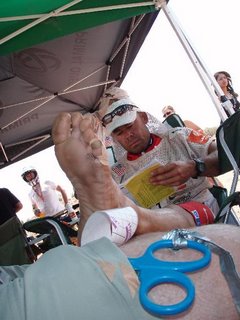 Ian Adamson of Nike PowerBlast gets his blistered feet patched up and ready for the final push to the finish line. (Photo by Dominic Casserly, courtesy of Casserly and Primal Quest.)
Adamson and teammates and rivals GoLite are the only teams that have passed Checkpoint 39, which marks a transition to mountain trekking. After that it's an incredible ropes section and a wild paddle.
His feet look ready for the final paddle. Keep checking here or Primal Quest for updates.
Largest ropes course - ever

That's what they're saying about the PQ-Utah course rigged by Jay Smith. While few details were shared about the course before racers arrived on the scene, Smith did reveal a few factoids:
12 – The average hours Smith worked every day that he spent rigging the course.
16 – The number of professional alpine guides on staff to help Smith staff the ropes.
30 – The number of days it took Smith and his assistant to rig the course.
50,000 – The number of feet of rope Smith’s team will manage during the race.
Read more here.
Mountains don't stop Colorado teams in Primal Quest
The lead teams will finish the 417-mile Primal Quest adventure race today. Team Nike PowerBlast had been neck and neck with Merrell/Wigwam for hundreds of miles, sometimes trailing them by a couple hours, but at about 10 last night, high in the La Sal Mountains, according to GPS data, Merrell got off course, made several wandering backtracks, and lost THREE HOURS looking for the route.
Nike wasted no time, blasting past them. Now they lead Merrell by about five hours.
GoLite is on Nike's trail, making a huge comeback after several strokes of bad luck. (see previous posts about their curse).
Two other Colorado teams, Nike/Beaver Creek and Salomon/Crested Butte are flying through the La Sals in the top 10, but don't expect any upsets, they are over nine hours behind the front.
The last challenge in this race is a wild technical rope section where teams must ascend a sheer face on a butte called Priest and Nuns, then rappel down the far side. The winning team collects $100,000.
That will buy a lot of ibuprofen, which they'll probably need.
Nike wasted no time, blasting past them. Now they lead Merrell by about five hours.
GoLite is on Nike's trail, making a huge comeback after several strokes of bad luck. (see previous posts about their curse).
Two other Colorado teams, Nike/Beaver Creek and Salomon/Crested Butte are flying through the La Sals in the top 10, but don't expect any upsets, they are over nine hours behind the front.
The last challenge in this race is a wild technical rope section where teams must ascend a sheer face on a butte called Priest and Nuns, then rappel down the far side. The winning team collects $100,000.
That will buy a lot of ibuprofen, which they'll probably need.
You know you wanna be there
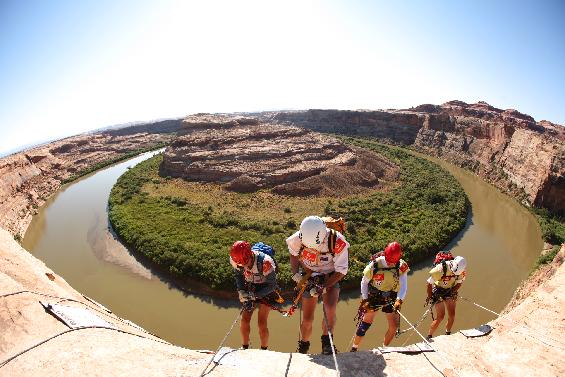 Maybe the members of Radioactive Beagles and 24Seven, shown here dropping down a cliff face to the river below, will return to actually enjoy this beautiful land they've been slogging through. Love this photo by Side Light/Corey Rich.
BTW, PQ site shows 17 teams have withdrawn from the race and the leaders are past Checkpoint 36 and are mountain biking the La Sals.
Oooh! Ahhh! Ouch!
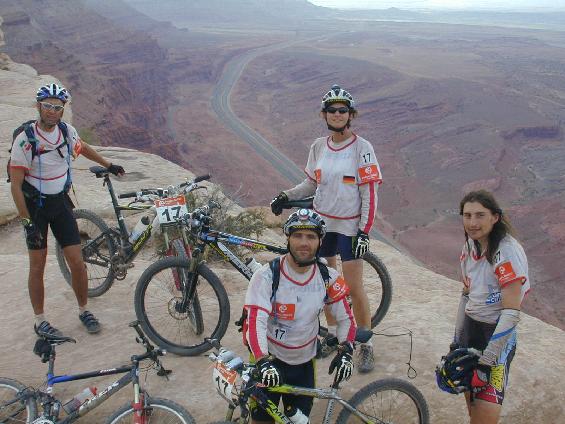
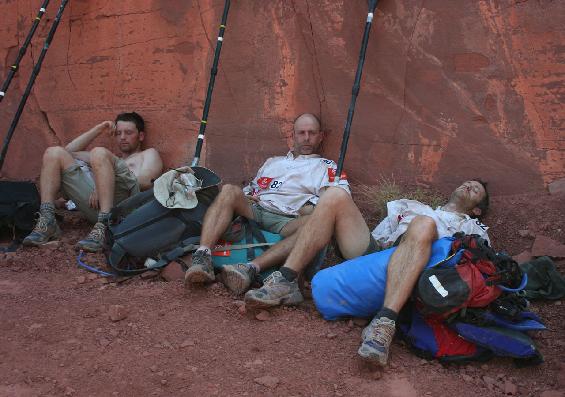
 Utah is beautiful country, but make no mistake: Primal Quest is a grueling competition. Thanks to the photographers and Primal Quest for use of these photos.
Top left: Team Hombres de Maiz stand on the edge of a remarkable cliff revealing a long drop to a beautiful bottom. Photo by Ken White
Top right: Duncan Coo, Chris Koch and Darin Nevin of Spirit take a rest while climbing the endless switchbacks between Transition areas 7 and 8. Photo by Richard Lambakis
Bottom: Ouch! This race isn't for the squeamish. Photo by Side Light/Tony DiZinno
Expect to see shots from Gazette photographer David Bitton in days to come. He's a desert rat this week, following PQ, but is wrestling a laptop with a mind of its own.
Racing to the finish

(Looking across to the La Sal Mountains from Transition Area 10. Leading teams are in the mountains or headed there today. Photo by Richard Lambakis, courtesy of Lambakis and Primal Quest.)
Good morning! I haven't heard from Dave and David this morning, but checking the Primal Quest Web site, I see Nike PowerBlast and GoLite/Timberland are past Checkpoint 35 and heavy into the mountain trekking portion of the race. They're in gorgeous country, the La Sal Mountains, but I doubt they're noticing.
Merrell/Wigwam is through Checkpoint 34 and SOLE is through Checkpoint 31. SOLE is on the lookout for Supplierpipeline, also through Checkpoint 31.
Continue checking in for updates and visit the PQ site for great photos, video and an interactive map.
Thursday, June 29, 2006
Upping the punishment
 (Jim Doucette of TnT Canada stops to give some much needed attention to his feet in this photo by Daniel Cassettari, courtesy of Cassettari and Primal Quest. According to PQ news, he'll need them for additional work in the next 24 hours.)
Primal Quest just got harder, according to the web site.
Not satisfied with the degree of punishment already inflicted, Don “Sweet Satan” Mann added a twist to the PQ course Thursday: a challenging orienteering course that the lead teams will have to navigate at night.
The race leaders will soon learn that 417 miles won’t be enough to finish PQ. In addition, they’ll have to find five orienteering marks, requiring about eight miles of hard navigation.
This addition to the race occurs at elevations above 10,000 feet, which should give Rocky Mountain teams an advantage.
The late-breaking addition will not come as a complete surprise to racers who read their official course books thoroughly, and interpreted the clues liberally, organizers said.
Primal Quest crew say it's likely racers won't be thrilled with the prospect of carrying a few extra hours worth of food up a 4,000 foot climb.
Good news, depending on your perspective
Environmental notes from the wire
Conservation group wins
An energy company is giving a conservation group petroleum leases on nearly 1,700 acres of federal land on the Rocky Mountain Front, where the mountains meet the plains south of Glacier National Park. The donation from Questar E&P to Trout Unlimited was announced Wednesday, one day after Sen. Conrad Burns, R-Mont., moved to permanently prohibit new federal oil and gas leasing on the Front. The company gave Trout Unlimited all of its Front leases, said Chris Wood, vice president of conservation for the nonprofit fisheries organization. They are within the Lewis and Clark National Forest. New oil and gas leasing on the Front ended with a Forest Service order in the late 1990s, but petroleum development using older leases remained possible. Last summer, the Interior Department suspended development of existing leases.
Loggers win, too
In Grants Pass, Ore., a timber sale in a national forest roadless area has been awarded to a logging contractor, despite efforts by conservation groups and the governor to stop it. The Mike’s Gulch timber sale was awarded Tuesday to Silver Creek Logging Co. of Merlin, Ore., after a federal judge in Medford decided it could go forward while he hears a lawsuit arguing the U.S. Forest Service should consider new scientific information, Rogue River-Siskiyou National Forest spokeswoman Patty Burel said. Meanwhile, a federal judge in San Francisco has yet to rule on a motion from Gov. Ted Kulongoski and conservation groups to stop logging in Mike’s Gulch until two other lawsuits challenging the Bush administration’s new roadless rule can be heard. The Bush administration has maintained that Mike’s Gulch is part of the salvage and restoration effort following the 2002 Biscuit fire, and that because the logs will be flown out by helicopter, no new roads will have to be built. The sale is the first in a roadless area since the Clinton administration generated rules in 2001 putting 58.5 million acres of roadless areas around the country off-limits to most logging.
Whales winning
The number of gray whales born along the Pacific Coast has rebounded from record low levels, suggesting that pregnant females are thriving despite a warming Arctic feeding environment, biologists said. The number of calves that passed Point Piedras Blancas near San Luis Obispo jumped from 945 last year to 1,018 calves in 2006, National Oceanic and Atmospheric Administration researchers said. Fewer than 300 of the 3-month-olds were spotted in 2000 and 2001. The whales appear to have taken advantage of melted polar sea ice, discovering new routes to food farther north near Barrow, Alaska, and finding enough crustaceans in the mud to nourish pregnant females, scientists said.
Geyser fans winning
In Mammoth Lakes, Calif., a popular section of a warm-water creek that bubbles with hot springs was closed to bathers after geysers began spouting from the riverbed. A 200-yard area around the Hot Creek Geologic Site was fenced off June 6 after Inyo National Forest rangers noticed geysers and steam. Geologists said the eruptions were probably due to heavy runoff from snow colliding with heat rising from magma miles below the valley floor. There were no signs of increased seismic activity in the region, which lies within the crater of a long-dormant volcano, according to a U.S. Geological Survey report released Tuesday.
Conservation group wins
An energy company is giving a conservation group petroleum leases on nearly 1,700 acres of federal land on the Rocky Mountain Front, where the mountains meet the plains south of Glacier National Park. The donation from Questar E&P to Trout Unlimited was announced Wednesday, one day after Sen. Conrad Burns, R-Mont., moved to permanently prohibit new federal oil and gas leasing on the Front. The company gave Trout Unlimited all of its Front leases, said Chris Wood, vice president of conservation for the nonprofit fisheries organization. They are within the Lewis and Clark National Forest. New oil and gas leasing on the Front ended with a Forest Service order in the late 1990s, but petroleum development using older leases remained possible. Last summer, the Interior Department suspended development of existing leases.
Loggers win, too
In Grants Pass, Ore., a timber sale in a national forest roadless area has been awarded to a logging contractor, despite efforts by conservation groups and the governor to stop it. The Mike’s Gulch timber sale was awarded Tuesday to Silver Creek Logging Co. of Merlin, Ore., after a federal judge in Medford decided it could go forward while he hears a lawsuit arguing the U.S. Forest Service should consider new scientific information, Rogue River-Siskiyou National Forest spokeswoman Patty Burel said. Meanwhile, a federal judge in San Francisco has yet to rule on a motion from Gov. Ted Kulongoski and conservation groups to stop logging in Mike’s Gulch until two other lawsuits challenging the Bush administration’s new roadless rule can be heard. The Bush administration has maintained that Mike’s Gulch is part of the salvage and restoration effort following the 2002 Biscuit fire, and that because the logs will be flown out by helicopter, no new roads will have to be built. The sale is the first in a roadless area since the Clinton administration generated rules in 2001 putting 58.5 million acres of roadless areas around the country off-limits to most logging.
Whales winning
The number of gray whales born along the Pacific Coast has rebounded from record low levels, suggesting that pregnant females are thriving despite a warming Arctic feeding environment, biologists said. The number of calves that passed Point Piedras Blancas near San Luis Obispo jumped from 945 last year to 1,018 calves in 2006, National Oceanic and Atmospheric Administration researchers said. Fewer than 300 of the 3-month-olds were spotted in 2000 and 2001. The whales appear to have taken advantage of melted polar sea ice, discovering new routes to food farther north near Barrow, Alaska, and finding enough crustaceans in the mud to nourish pregnant females, scientists said.
Geyser fans winning
In Mammoth Lakes, Calif., a popular section of a warm-water creek that bubbles with hot springs was closed to bathers after geysers began spouting from the riverbed. A 200-yard area around the Hot Creek Geologic Site was fenced off June 6 after Inyo National Forest rangers noticed geysers and steam. Geologists said the eruptions were probably due to heavy runoff from snow colliding with heat rising from magma miles below the valley floor. There were no signs of increased seismic activity in the region, which lies within the crater of a long-dormant volcano, according to a U.S. Geological Survey report released Tuesday.
Stop and see the wildlife
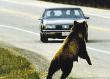 (A bear appears to begin making a quick about-face as a car approaches in this photo by Chuck Bartlebaugh, courtesy of the U.S. Department of Transportation.)
National Park visitors are killing the wildlife they've come sometimes thousands of miles to see.
“I call this the kill zone,” Moose Mutlow, a contractor with the Yosemite Institute, said of a sunlight-dappled stretch of road in Yosemite. “Animals crossing here just don’t stand a chance."
Tourists gawking at towering granite faces or roaring waterfalls often speed eagerly from one sight to the next, giving wildlife little chance to scurry out of the way, The Associated Press reports.
Tennessee’s Great Smoky Mountains National Park is the nation’s most popular, with more than 9 million visitors annually. It harbors turkeys, possums, groundhogs and bears in its half-million acres of mountainous forest. The park records about two traffic-related bear deaths a year, spokeswoman Nancy Gray said. “Speed is a factor,” Gray said. “A lot of time people are trying to get somewhere a lot faster than they should, and they’re in wildlife habitat.”
Mutlow spent 290 days surveying 30 miles of Yosemite highway twice daily. He found 250 animals, including squirrels, possums, skunks, coyotes, deer and bear, classifying them according to his “Appearance Index Matrix” — a subjective scale that ranges from “victim appears to be sleeping in a poorly chosen location” to “victim resembles badly molded pancake,” and “victim disassembled and spread liberally around area.”
In the grassy wetlands south of Montana’s Glacier National Park, so many western painted turtles are run over that observers might wonder if drivers take them for speed bumps. With up to 500 cars an hour traveling at 70 mph or more, it’s easy to see why many don’t make it, said Kathleen Griffin, a University of Montana researcher.
Over three years, Griffin counted 1,040 dead turtles along four miles of U.S. 93.
Standing aside the roadway, Mutlow shakes his head as another driver speeds over Ribbon Creek. “Drive a little slower,” he said. “It’ll add five minutes to your trip, but hey, you’re here to relax.”
Learning the ropes

Here's a peek at one of those critical points along the course - a rappel that required Primal Quest crew to lower the teams' mountain bikes down the cliff.
See posting below (from Wednesday) to read what happens when a bike gets snagged in the ropes hundreds of feet off the canyon floor. Oops.
At this point (the rappel) racers had already ridden two legs on the bikes - but they still had two to go. As Gazette reporter Dave Philipps notes, one of the last legs of PQ Utah is a ride that could set up a tire-to-tire finish. Watch for it early Friday - or, who knows, late tonight.
(Primal Quest crew lowers a mountain bike at Gemini Bridges. Photo by Adventure Art/Chris Halper, courtesy of Adventure Art, Halper and Primal Quest.)
Nothing seems to keep GoLite down
In Primal Quest, the 417-mile adventure race going on right now around Moab, Utah, the top teams have entered the last section of the race in the La Sal Mountains. Nike, the favorites, are in the lead. Merrell/Wigwam is on their heels, but the real story is GoLite. They are in third place after two fiascos that were no fault of theirs (see post below.)
Now the teams have a long, high-altitude trek that will give Colorado teams like Nike, Spyder and Solomon/Crested Butte an advantage. They finish with a fast, downhill mountain bike to a CRAZY rope traverse between two buttes.
The top teams are close enough that this could be an amazing finish. Look for it in the next 24 hours, maybe much less!
To see progress, visit the Primal Quest site.
Now the teams have a long, high-altitude trek that will give Colorado teams like Nike, Spyder and Solomon/Crested Butte an advantage. They finish with a fast, downhill mountain bike to a CRAZY rope traverse between two buttes.
The top teams are close enough that this could be an amazing finish. Look for it in the next 24 hours, maybe much less!
To see progress, visit the Primal Quest site.
Who's hanging in and who's out?
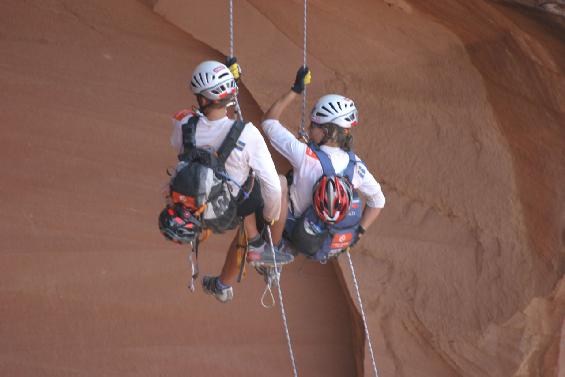
A quick check of the Primal Quest race site shows 6 teams have pulled out of the competition. Another 11 teams are Unranked. The leading teams have remained about the same.
Check the site for more news and tidbits from the route - like a racer using her undies to filter the silt from river water which was then purified for drinking. I think you can file that under "You know you're hardcore when..."
Another racer got a surprise visit from his wife and kids at a desert checkpoint. The kids probably boosted everyone's spirits.
(Halti members hang by a rope in this photo by Adventure Art/Chris Halper, courtesy of Adventure Art, Halper and Primal Quest.)
Wednesday, June 28, 2006
A snag on the ropes pulls one team back in Primal Quest
Some teams have all the luck, and some have none.
Team GoLite, a very good team that was expected to place in the top 10 of the 417-mile Primal Quest adventure race, started out the race with a sick horse. By the first checkpoint, it was reportedly bleeding out the nostrils, and vets on the course made them wait for an hour for the horse to rest before they pressed on. At the next checkpoint, a vet stopped them again. Before long they were several hours behind the leaders, but struggled to catch up.
By this morning, they were in 5th place (after dropping in the horse section to about 60th), and looking easily strong enough to take 4th place.
This morning started with a mountain biking section that led to a rappel at a natural rock span called Gemini Bridges. At the bridges, they slid down the ropes, while race staff lowered their bikes down on a 600-foot-long zip-line.
First Merrell came through early in the morning, dropped down the arch, and watched their bikes zoom down the pulley system. Nike Powerblast came through an hour later, followed shortly by SOLE and a VERY gaunt and tired team Spyder (they collapsed in the shade just after the rappel).
Then GoLite pulled up and rappelled down, but as their bikes were coming down the zip-line, one got its wheel snagged in the rope and the whole system stopped. The bikes hung motionless 400-feet above the canyon floor.
The rope team started jiggling the lines, then pulling on them madly. Meanwhile, the team waited helplessly while the leaders surged ahead. Finally, something gave. The snagged wheel flew off and crashed 400 feet down where the tube exploded with a tremendous BANG!
“I heard the tire, but how’s the wheel” the main rope worker radioed down to his assistants below. “It’s f*&@ed,” came the reply.
And the bike was still stuck in the ropes. It took another half hour to get it down. It’s an hour GoLite my not be able to make up. No word from race HQ on how they’ll make up for this goof that clearly wasn’t the team’s fault.
The rest of the pack is off on a classic mountain bike tour of Moab: Gold Bar Trail, Poison Spider Mesa, into the town of Moab, and up Pritchett Canyon. By nightfall they could be in the mercifully cool arms of the La Sal Mountains, and only a day away from the finish.
Team GoLite, a very good team that was expected to place in the top 10 of the 417-mile Primal Quest adventure race, started out the race with a sick horse. By the first checkpoint, it was reportedly bleeding out the nostrils, and vets on the course made them wait for an hour for the horse to rest before they pressed on. At the next checkpoint, a vet stopped them again. Before long they were several hours behind the leaders, but struggled to catch up.
By this morning, they were in 5th place (after dropping in the horse section to about 60th), and looking easily strong enough to take 4th place.
This morning started with a mountain biking section that led to a rappel at a natural rock span called Gemini Bridges. At the bridges, they slid down the ropes, while race staff lowered their bikes down on a 600-foot-long zip-line.
First Merrell came through early in the morning, dropped down the arch, and watched their bikes zoom down the pulley system. Nike Powerblast came through an hour later, followed shortly by SOLE and a VERY gaunt and tired team Spyder (they collapsed in the shade just after the rappel).
Then GoLite pulled up and rappelled down, but as their bikes were coming down the zip-line, one got its wheel snagged in the rope and the whole system stopped. The bikes hung motionless 400-feet above the canyon floor.
The rope team started jiggling the lines, then pulling on them madly. Meanwhile, the team waited helplessly while the leaders surged ahead. Finally, something gave. The snagged wheel flew off and crashed 400 feet down where the tube exploded with a tremendous BANG!
“I heard the tire, but how’s the wheel” the main rope worker radioed down to his assistants below. “It’s f*&@ed,” came the reply.
And the bike was still stuck in the ropes. It took another half hour to get it down. It’s an hour GoLite my not be able to make up. No word from race HQ on how they’ll make up for this goof that clearly wasn’t the team’s fault.
The rest of the pack is off on a classic mountain bike tour of Moab: Gold Bar Trail, Poison Spider Mesa, into the town of Moab, and up Pritchett Canyon. By nightfall they could be in the mercifully cool arms of the La Sal Mountains, and only a day away from the finish.
Agony and ecstasy
 I've been having trouble posting photos, but managed to throw a few on here.
If you haven't checked out Primal Quest's Web site, the photos alone are worth the stop. They capture the drama of this grueling race - and the humor in which many racers face the extreme conditions. Just a sampling: (other photo credits to come, when I find them again.)
Racers wrestle gripping rapids while cruising on boogie boards by Side Light/John Nantes
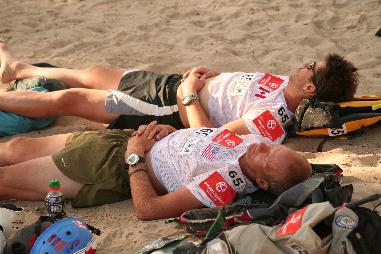
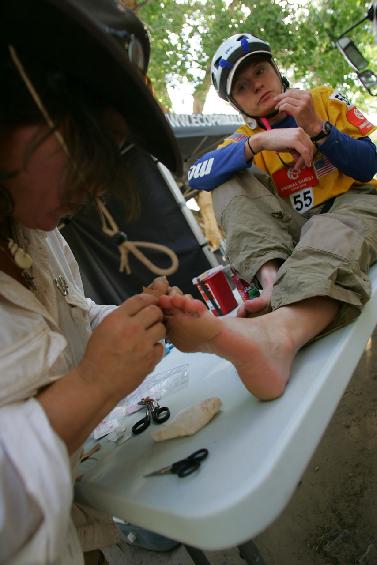
Bully for Boo
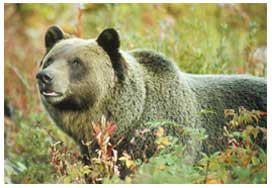 (photo from davco.bc.ca)
Never, ever underestimate the power of a grizzly bear that likes his freedom. Check out this AP story from British Columbia:
A freedom-loving grizzly bear named Boo smashed a heavy steel door and barreled through two electric fences to escape a second time from a resort near the south-central British Columbia town of Golden. Boo was recaptured Friday, two weeks after breaking out of an artificial den at the Kicking Horse Mountain Resort, but escaped from tighter confinement within a day, resort spokesman Michael Dalzell said Tuesday.
“It’s unbelievable,” Dalzell said. “We thought there was no way, it was absolutely impossible, but he found a way. It was basically like breaking out of Fort Knox.”
He said the bear bashed a nearly 400-pound steel door off its four bolts, destroyed an electrical box while tearing through two electric fences and scrambled over a 12-foot fence anchored with 2 feet of steel below ground.
“I think he just kept charging it (the door) and charging it until it broke off its bolts,” Dalzell said. “Everything was completely trashed. We are dealing with a pretty smart and determined bear.”
The search team that caught Boo on Friday went back to work Sunday morning but saw no sign of the grizzly after logging more than 50 hours in a helicopter. Resort staff had planned to neuter Boo, but he got away first. Once he’s located, authorities will decide whether to try to recapture him again, Dalzell said.
“Right now we are in the process of looking for him . . . we are not out to try to trap or tranquilize him,” he said. “We are looking at all options. Obviously, we need to just really look at our program and figure this one out."
The bear has lived inside a 22-acre enclosure since his mother was illegally shot by a hunter in 2002. It’s unclear if he could fend for himself and, being used to humans, would likely be a problem in the wild, experts said. Boo is now in a “lose-lose situation,” said Tracey Henderson of the Grizzly Bear Alliance in Canmore, Alberta. “The poor guy has now tasted freedom and he is going to be more motivated to keep getting out,” she said. “There is a side of me that’s saying, ‘Way to go Boo,’ but there is another side of me that’s really worried about this bear being in the wild near humans.”
Boo’s first escape was blamed on hormones, June being the prime mating season for grizzlies, but Henderson said the second escape might indicate the bear no longer would tolerate confinement. “It’s just a sad situation,” she said. “He is clearly a bear that wants to be free, yet we’ve created a situation where it’s not really safe for him to be free."
Watch for the newest ADT hikers

Robin Grapa, a 26-year-old survivor of bone marrow disease, and her mother, Patty Laatsch, are on the trail - the American Discovery Trail. The mother and daughter are backpacking across the country on the ADT to raise awareness and money for bone marrow disease research. They started their hike Feb. 4 in Delaware, and should be in the area this week.
The ADT takes hikers from Cripple Creek to Woodland Park, Green Mountain Falls, Colorado Springs, and on to Denver, Crested Butte and Grand Junction. If you want to help the hikers with food, water or a place to stay overnight, contact Jennifer Krammes at 1-800-747-2820 or krammes@aamds.org . Check out their journal www.ourhike.com
Tuesday, June 27, 2006
Smile for the cameras
Team Merrell/Wigwam arrived first out of a 100-degree canyon hike today, just over halfway through the 400-mile Primal Quest adventure race near Moab, Utah. At the top of the hike lay a 400-foot free rappel into the depths of Hell Roaring Canyon.
Californian Robyn Benincasa and New Zealander Ian Edmond were the first to drop over the edge. "Holy S@#%! These guys aren't messing around," Benincasa said as she backed down over the lip.
A few minutes of air later, she was on the ground.
The team's two other members, New Zealanders Jeff Mitchell and Neil Jones, followed so nonchalantly that Jones was literally yawning when he stepped over the precipice.
He and his mate stood there at the edge just long enough to thank the rope riggers for their help.
"Shall we drop into space Mr. Jones" Mitchell asked. "Why not?" Jones replied.
As they slid down the ropes five video cameras panned after them, including a nimble boom that could peer out over the cliff.
Adventure racing's premier events are planned months in advance to be friendly to TV, and gratuitous rappels like the one into Hell Roaring Canyon are added because, hey, that's good TV. The racers could have scrambled into the canyon a half mile farther down, but that's not really much fun to watch.
Much of the silly stuff the race directors dream up because it will look cool on TV, in the end, matters little to the race. The horse riding, the river crossings, the rappels don't usually add or take away much time for teams. It's the boring stuff (50 miles of walking) that weeds out the weak and punishes even the strong. This isn't to say these sections aren't important. They are. Good TV means lots of attention. Lots of attention means big money prizes. The top team gets $100,000.
People are naturally competitive and adventure racing can, and for the most part does, thrive with little attention outside of a small group of racers, but competition is also never hurt by a little exposure and a lot of money. So a little rappeling makes for a much better race.
Merrell had an hour lead over team Nike/Powerblast at the ropes, teams SOLE and GoLite were a half-hour behind Nike.
They now go down another canyon in the dark to the kayaks where they left their gear. Sometime Wednesday they'll bike into Moab (briefly) before pushing on to the mountains.
Californian Robyn Benincasa and New Zealander Ian Edmond were the first to drop over the edge. "Holy S@#%! These guys aren't messing around," Benincasa said as she backed down over the lip.
A few minutes of air later, she was on the ground.
The team's two other members, New Zealanders Jeff Mitchell and Neil Jones, followed so nonchalantly that Jones was literally yawning when he stepped over the precipice.
He and his mate stood there at the edge just long enough to thank the rope riggers for their help.
"Shall we drop into space Mr. Jones" Mitchell asked. "Why not?" Jones replied.
As they slid down the ropes five video cameras panned after them, including a nimble boom that could peer out over the cliff.
Adventure racing's premier events are planned months in advance to be friendly to TV, and gratuitous rappels like the one into Hell Roaring Canyon are added because, hey, that's good TV. The racers could have scrambled into the canyon a half mile farther down, but that's not really much fun to watch.
Much of the silly stuff the race directors dream up because it will look cool on TV, in the end, matters little to the race. The horse riding, the river crossings, the rappels don't usually add or take away much time for teams. It's the boring stuff (50 miles of walking) that weeds out the weak and punishes even the strong. This isn't to say these sections aren't important. They are. Good TV means lots of attention. Lots of attention means big money prizes. The top team gets $100,000.
People are naturally competitive and adventure racing can, and for the most part does, thrive with little attention outside of a small group of racers, but competition is also never hurt by a little exposure and a lot of money. So a little rappeling makes for a much better race.
Merrell had an hour lead over team Nike/Powerblast at the ropes, teams SOLE and GoLite were a half-hour behind Nike.
They now go down another canyon in the dark to the kayaks where they left their gear. Sometime Wednesday they'll bike into Moab (briefly) before pushing on to the mountains.
Exhaustion taxing Primal Quest teams
What a difference a day makes.
Yesterday, we saw four teams come running neck and neck into a checkpoint at a rappel deep in the Utah desert: Merrell/Wigwam, Nike Powerblast, Spyder and SOLE.
Today, after a 20-mile canyoneering hike and a 45-mile overnight kayak, the group had disintegrated. Some pushed on with no sleep. Some had tried to sleep but been plagued by bugs. Others had enjoyed a solid 2-hour nap.
The next checkpoint was in Mineral Bottom, a flat area at the bottom of a 600-foot-deep canyon carved by the Green River. Here the teams pulled their boats ashore and transitioned to a 30-mile canyoneering section with a long rappel in the middle.
It was 96 degrees at Mineral Bottom, so the trek through the canyons could floor some teams.
Merrell arrived at a checkpoint first with no other teams in sight. They looked strong and coherent enough to crack a few jokes. When the race directors asked them to drag the boats up onto the beach, then all the way up to a small dirt parking lot, a woman said, “What, do you want us to drag them all the way to Phoenix?”
Within a few minutes, they had filled up their water bottles and left.
Then came Spyder, 29 minutes later. But with none of Merrell’s gusto. Danelle Ballengee, the team’s only female racer, was limping badly due to blisters and was exhausted almost beyond being coherent. The team had tried to pull over and sleep during the night on the river, but had wasted an hour swatting mosquitoes instead of resting. Ballengee could not go on. After an excruciating half-hour in the medical tent getting her blisters drained and taped, she and her team crawled under a nearby bush for a two-hour nap.
Team Sole arrived while Ballengee was still in the med tent, smiling as usual. None of them was limping. The team’s female racer, Karen Lundgren, didn’t have so much as a blister on her pink toenailed toes, and was so chipper that when a teammate asked her to rinse out his socks, she jogged down to the river instead of walking. Pretty incredible 200 miles into the race.
Just as Sole was leaving, at 12:12, Nike Powerblast arrived, looking tired but calm, and with no major injuries. They had enjoyed over 2 hours of sleep before getting in their kayaks. The team is known for not wasting time in transition zones, and as expected, efficiently filled up water bottles, packed food, taped a few minor blisters, and left.
The race lead will now change often as teams stop to sleep at different times.
“Some teams push more in certain sections and some teams sleep more and save up for a leg ahead. They all have their own plan,” said Robyn Benincasa, Merrell’s captain. “That’s the nature of the beast. You just have to hope you have the better plan, that’s how you win.”
Yesterday, we saw four teams come running neck and neck into a checkpoint at a rappel deep in the Utah desert: Merrell/Wigwam, Nike Powerblast, Spyder and SOLE.
Today, after a 20-mile canyoneering hike and a 45-mile overnight kayak, the group had disintegrated. Some pushed on with no sleep. Some had tried to sleep but been plagued by bugs. Others had enjoyed a solid 2-hour nap.
The next checkpoint was in Mineral Bottom, a flat area at the bottom of a 600-foot-deep canyon carved by the Green River. Here the teams pulled their boats ashore and transitioned to a 30-mile canyoneering section with a long rappel in the middle.
It was 96 degrees at Mineral Bottom, so the trek through the canyons could floor some teams.
Merrell arrived at a checkpoint first with no other teams in sight. They looked strong and coherent enough to crack a few jokes. When the race directors asked them to drag the boats up onto the beach, then all the way up to a small dirt parking lot, a woman said, “What, do you want us to drag them all the way to Phoenix?”
Within a few minutes, they had filled up their water bottles and left.
Then came Spyder, 29 minutes later. But with none of Merrell’s gusto. Danelle Ballengee, the team’s only female racer, was limping badly due to blisters and was exhausted almost beyond being coherent. The team had tried to pull over and sleep during the night on the river, but had wasted an hour swatting mosquitoes instead of resting. Ballengee could not go on. After an excruciating half-hour in the medical tent getting her blisters drained and taped, she and her team crawled under a nearby bush for a two-hour nap.
Team Sole arrived while Ballengee was still in the med tent, smiling as usual. None of them was limping. The team’s female racer, Karen Lundgren, didn’t have so much as a blister on her pink toenailed toes, and was so chipper that when a teammate asked her to rinse out his socks, she jogged down to the river instead of walking. Pretty incredible 200 miles into the race.
Just as Sole was leaving, at 12:12, Nike Powerblast arrived, looking tired but calm, and with no major injuries. They had enjoyed over 2 hours of sleep before getting in their kayaks. The team is known for not wasting time in transition zones, and as expected, efficiently filled up water bottles, packed food, taped a few minor blisters, and left.
The race lead will now change often as teams stop to sleep at different times.
“Some teams push more in certain sections and some teams sleep more and save up for a leg ahead. They all have their own plan,” said Robyn Benincasa, Merrell’s captain. “That’s the nature of the beast. You just have to hope you have the better plan, that’s how you win.”
Fence them in

(Photo pf Pacific walrus at Cape Peirce, courtesy of U.S. Fish and Wildlife Service)
In a strange solution to a strange problem, federal wildlife biologists have built a 250-foot-long fence to stop walruses from plummeting off cliffs to their death on a Bristol Bay Beach in Alaska. About 30 bulls took the fatal plunge last year at Cape Peirce on Alaska's southwest coast, where thousands of the massive creatures gather to rest between meals.
According to the AP: If too many squeeze onto Maggy Beach, a quarter-mile-long strip of dark-brown sand, dozens may traipse up a chute and onto a grassy plateau. When it’s time to feed, the animals seem to beeline for the water, which leads them across the plateau and over a cliff that’s up to 150 feet above shore. Sand dunes used to block the chute. But over time, the3,000-pound walruses wore away the dunes, with help from the wind, and made their way up the chute.
Last week the biologists planted a $2,500, 3-foot-tall, wooden-slatted fence across the chute, biologist Rob MacDonald said. But it won’t be the barricade. It should work like a snow fence, creating sand dunes that pile up to16 feet high. That should keep the walruses from straying up to the plateau.
More than 12,000 walrus gathered at Cape Peirce annually in the1980s, said federal wildlife biologist Joel Garlich-Miller, making it the largest concentration of Pacific walruses in North America at the time. But the visiting herds dropped sharply for several years, with sometimes only dozens of animals showing up, he said.
Biologists aren’t worried the deaths will make a significant dent in the walrus population. The last estimate, in 1990, was 200,000, and a new count is under way.
With three days of PQ left, sleep is the ultimate strategy
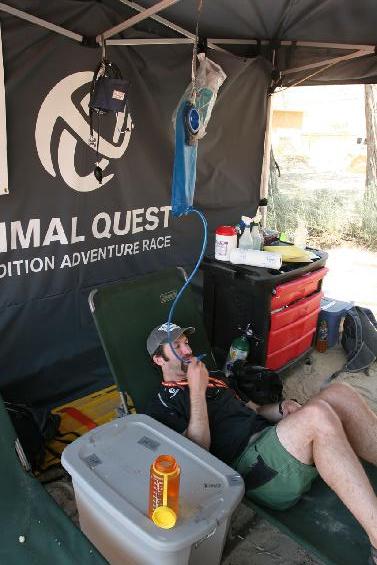
(A racer lounges in the shade, one of few breaks each member gets in a day. Photo by Daniel Cassettari, courtesy of Cassettari and Primal Quest.)
There is no yellow jersey for the lead team to wear in Primal Quest. That's because in this 417-mile race across the Utah desert that combines everything from mountain biking to swimming, the team at the front isn't necessarily the team in the lead.
Confused? Let me explain.
The race is expected to take about five days. Teams can stop to eat and sleep where ever and whenever they want. Most top teams sleep two to three hours out of every 24, either in 15-minute catnaps, or two-hour swaths. Where you decide to sleep alters the standings.
For example, on the online, real-time gps map that tracks the teams (www.ecoprimalquest.com) team Spyder and Team Merrill are way ahead of team Nike. But they walked all night to reach their kayaks and begin a 45-mile long paddle. Nike stopped at about midnight for a few hours of sleep. Now they're playing catch-up. But the exhausted teams in the lead will eventually have to stop too. It's like pulling into the pit in car racing. You know everyone will have to do it, so you try to do it when it will give you the biggest advantage.
Surprisingly, no lead team has stopped during the heat of the day yet, even with the lack of shade and near 100-degree heat, but from now on, the whole pack will be leapfrogging one another as the drive to stop and rest becomes stronger and stronger.
In the end, it's the most disciplined teams that will prevail. It's things like the condition of a racer's feet, not how fast he can run, that will decide who can keep going.
Well, OK, that's a little naive. At this level, the top teams are all disiplined AND fast. So the competition is world-class. Racers like Nike's Mike Kloser are so good I'm starting to think they're cyborgs -- Stepford adventure racers, all smiles and good sportsmanship with unstopping legs and an unquenchable hunger for pudding cups.
Our photographer ran with them for a few hundred meters yesterday afternoon (trying to catch the race to the rope rappels) and was barely able to keep up, even though they had been going for over 100 miles.
They're expected to finish sometime Thursday after a long trekking section in the La Sal Mountains.
Subscribe to:
Posts (Atom)