Wednesday, March 22, 2006

Who's reading this blog?


We have a tool here in the newsroom that lets us see how many users view this site, when, for how long and, most interesting to me, where they navigate from to get to our page.
Most of our visitors come from gazette.com, or our excellent Out There Web page, outdoors.coloradosprings.com.
But some people end up here after searching on Google for phrases like "skier, tree" or "Iditarod, Colorado."

The most recent search was "Fourteeners, Jesus."
I'm thinking this guy was a local.

To see the Google results of this search, click here.

A tour of the burrow from the BLM

B
The Bureau of Land Management has started a cool occasional online series called "Road Trips."
The monthly e-mails highlight a program or region of the state that the BLM works with. And it's not the typical "been there, done that" stuff you find in most fliers.
This month, the road trip gives a detailed tour of the Black-Footed Ferret reintroduction program in northwestern Colorado. To see it, click here . Generally, the tour is pretty good. It tells readers the history of how the ferrets grew from a wild population of just 18 in 1985 to a meticulously managed population of about 1,000 today.
It does leave out that Colorado's population has had almost no success in reaching the goal of a reproducing wild population, but it does give readers links to some good ferret-centered nonprofits that offer more info.
You can see the latest road trip at www.co.blm.gov.

Tuesday, March 21, 2006

An ode to winter

It's spring, and the snow is leaving the foothills. Soon, it will be gone from the mountains. As a fond farewell to a memorable winter, I offer up this excerpt from one of naturalist and Rocky Mountain National Park advocate Enos Mills' essays called "In a Mountain Blizzard". In this essay, Mills, who frequently sought out the barren summits of peaks along the Continental Divide, tells about a battle he and his dog Scotch waged to survive a blizzard:
"At last I realized that I must stop and spend the night in a snow-drift. Quickly kicking and trampling a trench in a loose drift, I placed my elk-skin sleeping-bag therein, thrust Scotch into the bag, and then squeezed into it myself. I was almost congealed with cold. My first thought after warming up was to wonder why I had not earlier remembered the bag. Two in a bag would guarantee warmth, and with warmth a snow-drift on the crest of the continent would not be a bad place in which to lodge for the night."

Back to the beginning


Here's a trivia question for you: Which Colorado ski area hosted the first snowboard competition?
(Bonus question: What year was it?)
If you remember the contest at Ski Cooper, you're right. If you remember the year, you're really good. If you were there, you're old!
In 1981, Cooper opened its slopes to a strange and virtually unknown competitive sport - snowboarding. To commemorate the silver anniversary, Cooper is hosting "Return to King of the Mountain," a celebration of the sport that transformed ski resorts. The event will feature legendary snowboard pioneers competing on antique equipment furnished by Burton, Sims and Winterstick. There's also a rail jam open to the public, and live music. Check it out April 1 (closing day) at Cooper.

Hot Wheels


I just paid a visit to USA Cycling and got a chance to see what the U.S. team mountain bikers are riding in 2006, and it's hot.
They're on the Specialized S-Works bike: a carbon frame, disc brakes, top-of-the-line components and the most awesome rear suspension I've ever tried. The new Brain shock automatically adjusts the suspension from firmly efficient in smooth terrain to fully active in the rough stuff. Most of the time, it feels like it's a hard tail, but get into the rocks, and it immediately softens up. Very, very cool. And light, and responsive -- a race horse.
I was lusting after it. I was even thinking of turning in my old Univega.
Then I saw the MSRP: $7,800.
Wow. Too close to how much I paid for my car.
Can anyone recommend a good, all around bike that is a good value?

What are these guys learning at CU?

The Rocky Mountain News had a story today detailing how four guys from CU got lost while snowshoeing on Mt. Princeton.

These guys did just about everything wrong: They wore all cotton in a wet snowstorm; they left the trail to find a "short cut" down; they split up.

They were rescued at about 11 p.m. after calling search and rescue on a cell phone.

The rescuers said the hikers were aloof and expressed little gratitude. But the father of one young man later said the hikers would say thank you and send a hefty donation to search and rescue.

Anyone looking for basic advice before heading into the backcountry could do well reading a Gazette article with Colorado Mountain Club trip leader Bill Houghton. In short, be prepared.

And should you need help, always thank your rescuer.

Coalition Building


The head of the Nature Conservancy in Colorado, Charles Bedford, had an op-ed piece (posted below) in The Gazette today lauding a new $7 million buffer zone around Ft. Carson. Turns out, what's good for artillery ranges is good for Bambi lovers too.

The problem for the fort was this: The exurbs of Pueblo West were creeping in on the southern flank. Battalions of doublewides, each on about five acres (none with any water), had taken a position on the eastern front. I was doing trail work with a young captain one day last summer and he was grousing about the doublewide residents complaining every time the practices at Ft. Carson's gunnery range got too spirited. According to him, people even had their windows blown out.
What could Ft. Carson do? It's not going to stop lobbing shells, so it started buying people out to create a strip of undeveloped land around its proving grounds.

It turns out this strip is critical for the Nature Conservancy's master plan to maintain an undeveloped corridor on the rapidly urbanizing (or at least suburbanizing) Front Range. The group already owns the 41,000-acre Bohart Ranch southeast of Colorado Springs, which links up with two other conservation-minded ranches to the west, Chico Basin Ranch and T-Cross Ranch. These lands connect with Ft. Carson. On the west side of the post, the Nature Conservancy owns the 1,600-acre Aiken Preserve. The preserve connects to the Pike National Forest.
Together, these properties form a strand of undeveloped land stretching from the low cholla cactus flats to the icy alpine summits, creating a corridor in which animals can travel relatively freely.

So, everybody wins. Well, everybody except the people who didn't want to move out of the buffer zone.

The thing about this that I think people often overlook is that in this military town, the military bases act like open space buffers already. What would Colorado Springs look like without Ft. Carson and the Air Force Academy acting like bookends? It's not a pretty picture.

The guest commentary by Charles Bedford:
Fort Carson buffer zone a Boon to region
By CHARLES E. BEDFORD THE NATURE
CONSERVANCY OF COLORADO
The Army’s recent allocation of an
additional $7 million to conserve buffer zone lands around Fort Carson will
protect not only our country’s military preparedness, but also our state’s natural heritage. The leadership and vision exhibited by U.S. Sen. Wayne Allard, Rep. Joel Hefley and the Army have begun a stream of financial and community support to an effort that ultimately will safeguard the open space and beauty of this region. Rapid urban development and loss of natural areas around military bases across the country pose a growing challenge to both military training needs and the conservation of significant wildlife habitat. As housing and other human development creep closer to military base borders, restrictions are often imposed on military activities, which can undercut the realism and effectiveness of training. This rapid development also poses an obvious threat to the relatively undeveloped lands surrounding Fort Carson, including land that is critical for four rare plant species that are found nowhere else in the world. In addition, species of concern such as the
mountain plover rely on the area for habitat. Mexican spotted owls, ferruginous hawks and herds of elk and pronghorn also depend on these lands. Fort Carson is in the bullseye of development pressures. In the last decade, the population of Colorado Springs has grown 30 percent,
topping a half-million and making Forbes Magazine’s list of “Steroid Cities.” As Colorado Springs continues to invest in its growth, we must also invest in preserving the open spaces and diverse wildlife that make Colorado such wonderful place to live. Under the Department of Defense
buffer program, the military, state and local governments, conservation groups, and landowners are all working together to protect training, quality of life, traditional lifestyles and natural resources. Activities involving private land are undertaken with the full endorsement of willing landowners.
In these days of fiscal constraints and increasing conflicts over land use, a policy that accomplishes multiple public benefits with one action and that is based on cooperation and collaboration rather than conflict deserves everyone’s support — and certainly has ours. While Allard’s and Hefley’s leadership has allowed us to make great progress, there is more work to be done. Only about half of the land in the buffer zone around Fort Carson is now protected under this voluntary collaborative partnership. We’re at the 50-yard line with a long way to go. But with the leadership of our legislators and the Army, and the support of willing landowners seeking to preserve their way of life and of the local community, we know we can go the distance. Building on this momentum, The Nature Conservancy of Colorado has launched the Peak-to-Prairie Project in partnership with Colorado Open Lands and the local ranching community to protect a landscape stretching east from Cheyenne Mountain to the Chico Basin and Bohart ranches, knitting together a series of protected lands and preserving open spaces between Colorado Springs and Pueblo. Neighboring ranchers are a critical part of the buffer effort. The shortgrass prairie ecosystem needs large, unbroken landscapes to thrive, and ranches provide some of the best remaining large
examples of this system. Sustaining wildlife and our agricultural heritage go hand-in-hand. Ranchers, military staff, public agencies and local people are coming together in an unprecedented way to make this a very exciting, crucial time for the region. What we do today will determine what this
landscape will be 10 years from now. Here, now, there is the chance to protect huge parcels of land owned by just a few people. In a very real sense, the team effort will define the future of this community. It’s no wonder Fort Carson is becoming a model throughout the country for how to use buffer zones to enhance wildlife and quality of life while preserving traditional lifestyles and military needs. The Nature Conservancy stands with so many others in the Colorado community to say thank you to Allard and Hefley and to the Army leadership at Fort Carson and in the Pentagon for their stamina and wisdom in protecting the community values embodied in this special place. Bedford is state director of The Nature Conservancy of Colorado former director of the
Colorado State Land Board.

Monday, March 20, 2006

Psst. Fence. Pass it on

You love 'em or you hate 'em. We're talking prairie dogs. North of here, in the Boulder/Broomfield counties area, folks just can't agree about the little critters. So they're compromising by putting up a fence, according to an Associated Press story that moved this weekend. The 2,400-foot fence is supposed to keep the 'dogs on the Boulder side, where they are protected, and keep them away from the Broomfield side, where they are despised. Volunteers erected the fence out of chicken wire and pegs that they hope will keep the prairie dogs on the side where they are welcomed. Will it work? Boulder County wildlife biologist Mark Brennan explains that prairie dogs will walk until they reach a vertical barrier and then try to dig under it. A two-foot apron of wire is designed to stop them, but Brennan says the persistent animals will eventually find a way over, around or under the fence.

Banquet-bound?


Here's another reason to hurry your team of sled dogs along in the Iditarod - if you're slow, you might miss the banquet. The 2006 Finishers Banquet took place Sunday night in Nome, Alaska, where awards were handed out. Sixty-five mushers attended, but five others hadn't finished the race yet. (Note to Colorado musher-watchers: Bill Pinkham of Glenwood Springs came in 40th; Buena Vista's Lachlan Clarke finished 63rd of 83 teams.

Natural vs. Synthetic clothing


14er Skier Lou Dawson had an interesting post this weekend about the benefits of wool versus synthetic layers.
His take: both are good, but when it comes to a light, next-to-skin fabric, the new, soft wools win. They're warmer when they're wet, and can still stop the stink almost as much as an anti-microbial synthetic shirt.

A growing number of outdoor companies are going back to wool and wool blends, including, of course, Smart Wool, Ibex, Ice Breaker and Ortovox.

In the snow, a sign of spring

I was on a backcountry ski in Summit County Saturday when this current storm-system first moved in. A friend and I had skied to the top of 11,400-foot Georgia Pass. Just as we reached the top, the front of the storm hit. And even though it was snowing, we heard a sure sign of spring in the form of thunder grumbling up in the clouds. We didn't see any lightning. But the thunder cracked and echoed off the hills. It sounded like summer.
It won't be long now until all the snow, even in the high country, has melted away.

A big storm that was supposed to drop up to a foot of snow on Colorado Springs wasn't all it was cracked up to be. The north end of town and Woodland Park got about four inches, but the center of town got just enough to make it icy for the morning drive.
Yesterday afternoon, I was out walking with my wife in the sunshine, and she said, "You know, I hope it does snow really, really hard. I love those big storms."
And the snow swept in hard a few minutes later, but only lasted for about a half hour. Just enough to water my flowers... and freeze them.

Sunday, March 19, 2006

Space odyssey


Sure, there's new snow in the mountains. But that's not what I've been watching this morning. I'm checking out my favorite peak in a faraway place - Mars. The Gazette reported Sunday morning that Google has introduced its Mars mapping tool. The interactive site allows users to check out the red planet in three formats - color-coded by altitude, in black and white photos, and on an infrared map that shows temperature variations. So instead of watching our own mountains, check out Hecates Tholus, a bumpy little volcano that is about 18 kilometers high.

Friday, March 17, 2006

Division of Wildlife turns attention to gas drilling


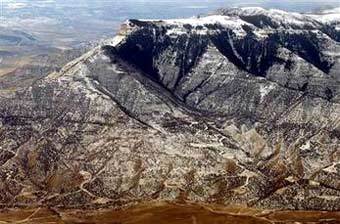
With gas drilling popping up across Colorado on places such as the Roan Plateau (left) at a never-before-seen rate, the state Division of Wildlife has added a special liaison to deal with wildlife related energy issues.

Here's the press release:

DOW HIRES LIAISON TO ASSIST WITH ENERGY DEVELOPMENT ISSUES
In the face of increasing energy development in Colorado, the Colorado Division of Wildlife (DOW) has hired an Energy Liaison to assist in outreach efforts with the energy industry and federal and state regulators.

Kim Kaal, a certified professional geologist, was hired to fill the energy liaison position and began work on Mar. 1. Kaal has served as an environmental consultant to the energy industry and was environmental coordinator for EnCana in western Colorado.

"Working for years in the energy industry, I've seen how balance can be achieved between energy development and wildlife," said Kaal. "This position gives me the opportunity to work with industry and provide methods and concepts that can be used to minimize impacts."

Kaal is stationed in the DOW Northwest Region office in Grand Junction. "Energy development in northwest Colorado is occurring in the same areas that are home to the largest migratory mule deer and elk herds in the nation," said Ron Velarde, northwest regional manager for the DOW. Velarde oversees wildlife efforts in nine counties, including Garfield County which leads the state in operating drill rigs and number of permits issued for new wells. The challenge of mitigating the impacts of energy development is not just limited to one area, which is why the energy liaison will serve as a statewide authority on the energy industry.

There has been increased natural gas exploration across western Colorado, including the HD Mountains of southwestern Colorado. Beyond the natural gas boom the state is experiencing, Kaal will assist DOW staff with preparing comments regarding efforts to mine Colorado's low-sulfur coal deposits, potential oil shale development, oil wells along the Front Range, increased emphasis on wind and alternative energy, and interest in the state's uranium deposits. "Having someone with Kim's expertise and knowledge of geology is critical for the DOW," said Velarde. "We have a great deal of biological knowledge, but industry speaks a different language. Kim gives us someone who can translate our message to industry and bring industry discussions back to our level. It's not an easy job, but it's an essential job."

The DOW has no authority over energy extraction but serves in an advisory capacity for many land use agencies and regulatory bodies. The DOW is statutorily mandated to protect and enhance Colorado's wildlife resource.

Skiing this weekend? Here's the conditions


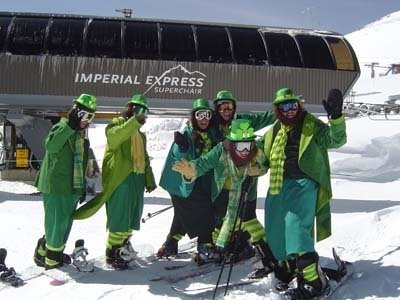
Fortunately, this is the only green you'll see this weekend. The resorts still have great coverage. No grass sticking through in this state. Summit and Eagle counties both had more than a foot of new snow this week and cold temperatures have kept it in great conditions. All the ski areas are calling for a little snow this weekend, but not enough to make driving hairy.
The bottom line: You won't find epic powder but get out early and enjoy prime corduroy.

Spring Break breakdown


If you haven't noticed the huge number of white license plates heading up Highway 24, spring break is in full effect at the ski resorts.
That means long, sunny days, corn snow, and lots of free entertainment on the mountains.

Here's a run down:

Vail has Skiing magazine's top-rated spring break party with its "Spring back to Vail" featuring huge free concerts (last year was Snoop Dog, this year's headliner hasn't been announced), an expanded amount of open terrain and the World Pond Skimming Championships. Check www.springbacktovail.com for details.

Breckenridge has the Spring Massive, with slopestyle and rail jam competitions for jibbers, and Breckenridge Bites, a townwide festival (April 1 -23) that allows diners to sample a three-course meal at participating restaurants for $15-$25. The season ends with two local traditions: the Imperial Challenge, a bike, hike and ski race up and down Peak 8, and the Bump Buffet, a telemark bump contest with lots of attitude and canned beer.

Copper Mountain has live music every weekend in April for its Sunsation fest, including everyone from reggae party standard Toots and the Maytals to Malian fusion rocker Toubab Krewe.

Winter Park's Spring Blast (March 25-26) will feature free music by Velvet Love Box, a rail jam, and free clinics on bump and tele skiing.

Echo Mountain Park has night skiing for $10!

And of course, no special events needed, the Arapahoe Basin beach scene is in effect.

Don't forget your sunscreen.

Thursday, March 16, 2006

Incline times: what means what?


Let me just throw this out there, with the understanding that the Manitou Incline lies partially on private land, and hiking it is trespassing:

How do your tresspassing times compare with others?
This is just a rough list. Please comment below and we'll adjust it:

If you can do it in...

One hour, you're slow, but deserve respect for doing it at all.

50 minutes, you probably didn't stop to rest, even though you wanted to. Good job.

40 minutes, you move slow and steady. You're probably an incline regular.

30 minutes, you probably run races on the weekend for fun.

25 minutes, you probably come close to winning races on the weekend for fun, and pass everyone else on the incline.

20 minutes, you are one of the elite athletes in the city.

18 minutes, you are Matt Carpenter (when he still did the Incline) i.e., you are the fastest hill climber in the state, if not the whole country.

Motorcycle diaries


Mike Jacobs just finished a motorcycle trip from his home in Black Forest to Tierra del Fuego on the southern tip of Argentina. Now he's riding back.
He's keeping a great
online journal.

Some of the choice entries I found in a quick glance include this one:


Ride from Popayan to Ipicles, Colombia

Welcome to Switzerland without the snow. My partner Luis agreed the country side and the views were Switzerland. Only the buildings were Latin America.

Most of the towns were picturesque with different color row houses and shacks.

Interesting sights and events were
1. Beautiful waterfalls;
2. Riding the mountain ridge line and overlooking two deep valleys by just turning my head 180 degrees,
3. Seeing bicyclists hitching rides up the hills by hanging on the tailgates
4. Rivers far below in the valley.
5. Meeting an Italian bicyclist riding from Mexico to Peru. At the time he was repairing his inner tube.
6. Washing the bike for about on hour.
7. Finding an altitude of almost 11,000 feet where it was 62’F.
8. Changing temperature from 100° F to 53° F in Ipicles.
9. Challenging the army on a bridge! The army has soldiers stationed at most bridges in Colombia. On a very long bridge I stopped in the middle to take a photo. The soldiers at both ends started waving at me and were coming at me. I took my photo, and started rolling again and showed the camera as I blew past the guard. He waved back.

From Popayan to Ipicles, Colombia was another fabulous ride through the mountains. The road was mostly maintained but had about 100 miles of needed repair.

I bottomed out the kickstand once. Also was very careful on the mud covered spots in the road.

Guards about every twenty or more miles.

We bargained the Hotel Mayasquer ‘down from $20 pp to $ 10 pp. This hotel is 300 feet from the Ecuador border and we walked it. It is a Travelodge and we were the only guests. They locked up our bikes in a garage attached to the hotel so we could walk to them inside. Address Avenida Paramedical Km 3 Via Rumichoca,phone 7734062, http://www.klrog.com/JournalofTierraDelFuegoTrip.html

Luis found out he needs a visa to get into Ecuador. Tomorrow will find out his entry.

Note 1. Technical
Popayan has two Kawasaki dealers. I know this because stopped I stopped at the first and Asked for a speedometer cable. They called the second one and within minutes I had a replacement delivered to me. Cost $ 8. Try that in the U.S.

Note 2. Army guards and police.

I drive by all checkpoints at about 60 mph while also passing cars and trucks who slow down for them. So far all I get is a wave, thumbs up, or a whiplash head turn.

This has been my practice in all countries.

So far, no high speed chases or gunfire.

There are no speed limits for motorcycles. They figure most bikes can’t speed.

Also motorcycles do not pay tolls in Colombia. There is a special 2-foot-wide bypass with ropes at both ends.

Miles: 215
Food $1, gas $6, lodging $10


By the way, I don't have any pictures of Jacobs on his motorcycle, (the one above is an actor portraying Che Guevara) But you can see pictures of Jacobs here.

Wednesday, March 15, 2006

Over 1,151 miles later, Iditarod is over


Well, at least it's over for the winner, Jeff King.
Local musher Lachlan Clark, who lived for several years in Colorado Springs and now lives near Buena Vista, is in 52nd place and still has 200 miles to go, according to the Iditarod Web site.

Old skiers usually have beards


Women live longer, but men ski longer. At least, that's what studies suggest.
According to a story in the Vail Daily "Research by the National Ski Areas Association shows that women make up a declining percentage of skiers as the population ages beyond 40. At age 40, women make up just under 50 percent of skiers. At 47, women make up 40 percent of skiers and snowboarders, and by 67, just over 30 percent of skiers and snowboarders are women."

Why? The study cites possible answers, such as that women like to ski in groups, and as fewer and fewer are able to ski, they discourage women still in skiing shape. I'm sure there are a number of other factors.
I will say, though, that I know at least four women over 60 who are better skiers than I am. And I'm happy they still hit the slopes, because they're usually willing to give me some pointers.

Tuesday, March 14, 2006

What choo talkin 'bout


The storm has cleared in the San Juans, the sun is out, and Wolf Creek has reported 104 inches, which is exactly two Gary Colemans stacked on top of each other.