Friday, March 31, 2006

Ready to suffer: the Elk Mountain Traverse Check-in


I arrived in Crested Butte today for the 40-mile Elk Mountain Traverse ski race over the mountains to Aspen. We'll start at midnight so we can pass over some dicey avalanche zones at dawn before the sun loosens the snow. Now, we're packing and waiting.

As you can see, we have a lot of stuff to cram into our packs, but we have no choice; most of the stuff is required by the race organizers. We showed up this morning to have our packs checked by the judges to make sure we had everything from sunglasses to a stove.

There were about 250 other racers with their skis and packs. The scene was about what you would expect, bearded mountain folk with ratty, sun-faded baseball caps and $150 sunglasses -- and a surprising number of blue eyes.

My lovely wife, Amanda, ever the terse observer, said, "What a surprise, a bunch of white people paying to suffer in their free time." I had to agree. Looking around, you could sort of understand how Leif Eriksson got some guys to willingly sail to find the new world in an open boat.

We have 4 1/2 hours until the race starts. Now we just nap and wait and pack and re-pack. The weather looks good. It should be a balmy 19 degrees when we start tonight. Little wind. A slight chance of snow.

I can't help but think dawn will find us in good shape. Though, I have to say, last time I pulled an all-nighter, it was in college and involved beer. We'll see how it goes. The key, as Matt Carpenter would say, is CFM, constant forward motion.
I won't have a chance to post again until after the race. Don't expect it to be coherent.

First to shred


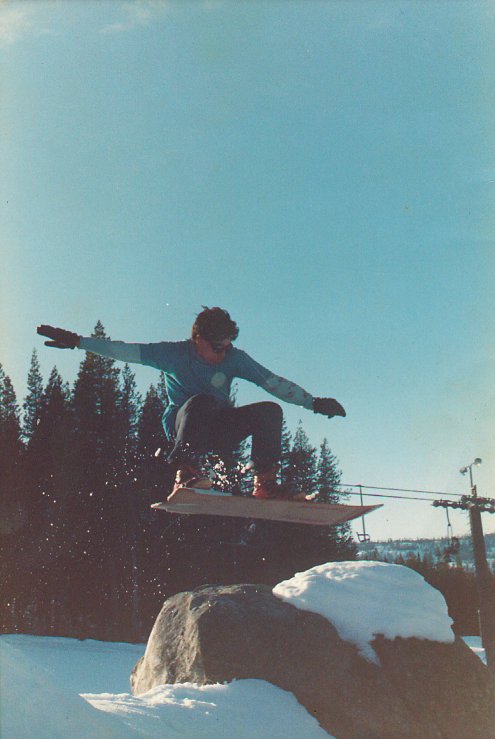
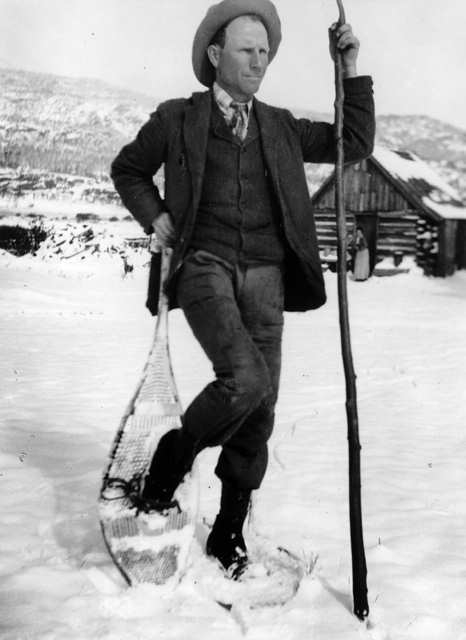
Wondering what the first mass-market snowboards looked like? How they rode? Head to Ski Cooper on Saturday and find out. Cooper's hosting its King of the Mountain competition and exhibition to mark the 25th anniversary of regional snowboard competition.

There'll be slalom and downhill races and a rail jam open to the public. Cooper got 4 inches of snow Thursday and closes Sunday, so there's no putting this one off.

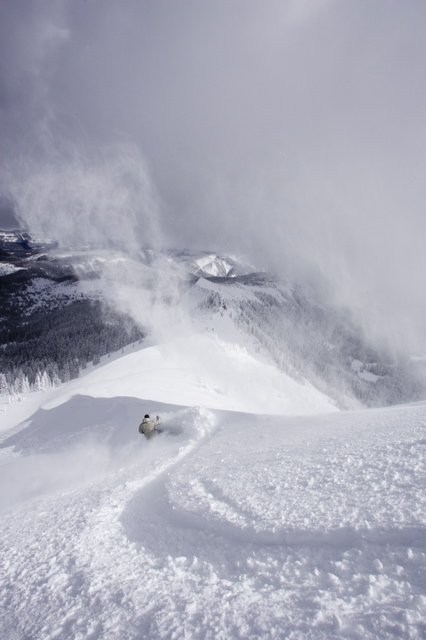
The photo? According to freebeer1981.com, it's a Bryce Kanights photo, circa 1984, of Tony Guerrero on an old Burton board. Plank.

--Dena

Should you stay or should you go?


What's a Front Ranger to do when forecasts call for weekend weather great for hiking and biking, yet there's fresh snow and mere days left till most resorts call it quits for the season?

Colorado Ski Country USA, the state's ski resort hub, reports fresh snow across the mountains, from 11 inches at Vail, to 15 inches at Durango, to 24 inches - WOW - at Silverton.

It's a win-win. Whether you stay here or head uphill, do SOMETHING. This isn't the weekend for computing your tax return. Get out there.

And check here Sunday to see how Dave did on his first run at the Elk Mountains Grand Traverse (backcountry skiing 40 miles from Crested Butte to Aspen).

-Dena
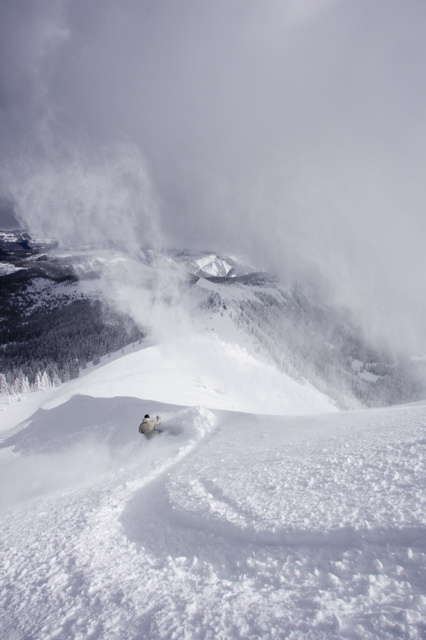
(No, that photo's not from this week; photographer Christian Murdock shot it earlier this season at Steamboat.)

Thursday, March 30, 2006

Robin watch

A Gazette caller was worried. "Where are all the robins this spring?" she asked. "They're gone!"

Well, they aren't gone, except maybe from that caller's backyard. Risë Foster-Bruder, president of the Aiken Andubon Society, assured us that robins haven't vanished. It's just that they have abandoned their popular harbinger-of-spring role for year-round residency. In fact, the last Christmas Bird Count turned up 295 robins, compared to fewer than a dozen the year before.

Foster-Bruder says robins will move around in winter to avoid the nastiest weather, and then return to higher ground.

Green vs. greens

People are taking sides in the recently announced proposal to build a nine-hole golf course in Bear Creek Regional Park. The golf enthusiasts who have approached the county with the proposal believe the land, 50 acres south of the park headquarters and east of 21st Street, is perfect for a gold course. Opponents, including the Trails & Open Space Coalition board of directors, believe it's perfect without a golf course, and that golf courses don't follow the new Parks Master Plan.

Here's the sticking point: The land is not developed now other than hiking trails. Whether that's a good thing or a bad thing depends on your point of view. Many want to preserve it as a little undeveloped jewel in the heart of the city. Others would love to see another golf course, even though the region already has 31 (private and public). But everyone agrees on one point: "It's a beautiful piece of property," said course proponent Judy Bell in an article in The Gazette March 25. (Check out the area south of the community gardens on this map.)

The parks department has scheduled a public meeting at 7 p.m. April 11 at the Bear Creek Nature Center, 245 Bear Creek Road.

Lynx on their way

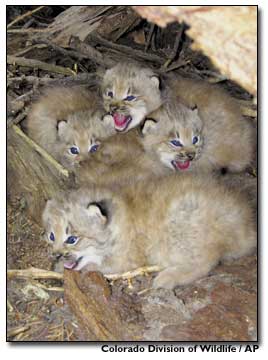
The Canada lynx population of Colorado will increase by four Saturday. That's the day the Colorado Division of Wildlife will release four lynx from the Yukon Territory and British Columbia. The program to reestablish the lynx in Colorado was started in 1999. Since then, wildlife biologists have released 218 of the big-footed cats in Colorado, mostly north of the town of South Fork and in an area bordered by Leadville, Buena Vista and Vail.
Lynx by the numbers:
4: Number that will get their first glimpse of Colorado Saturday.
14: Number to be released in April.
50: Number of kittens born in 2005.
78: Number of lynx confirmed dead since program began.
105: Number of kittens born since 1999.
140-200: Number of lynx living in Colorado now.
218: Number of lynx released in Colorado since 1999.
The DOW has more information on its Web site: http://www.wildlife.state.co.us

Start thinking Wolf Creek


The storm front causing high clouds on the Front Range is heading smack dab into Wolf Creek Pass. Wolf Creek ski area got 14 inches of fresh snow in the last 48 hours. It's snowing there now, and more snow is predicted Saturday and Sunday.

Sunday is Wolf Creek's last day, and it also happens to be a "local appreciation day," which means half-price tickets for everyone, no matter where you're from.

If you've been talking about making the 3.5-hour trek down to the Wolf all winter, now is your last and best chance.

Wednesday, March 29, 2006

The power of trees

This shouldn't come as a surprise to people who love trees: A series of studies at the College of Agricultural, Consumer and Environmental Sciences at the University of Illinois, Urbana-Champaign, has shown that trees actually enhance our lives. Researchers there look at the impact of the physical environment in the inner city on people.
Their studies showed:
- In an inner-city residence, the greener the neighborhood, the lower the crime rate.
- Girls who can view nature from home score higher on tests requiring self-discipline and concentration.
- Symptoms of children with Attention Deficit Disorder (ADD) are relieved after contact with nature.
- Inner-city neighborhoods with more trees and grass in common areas are used more by residents, who form relationships made stronger by the greenery.
- Green spaces can help relieve the stress associated with poverty.
- Inner-city families with trees and green spaces close-by have a safer environment than those in barren spaces.
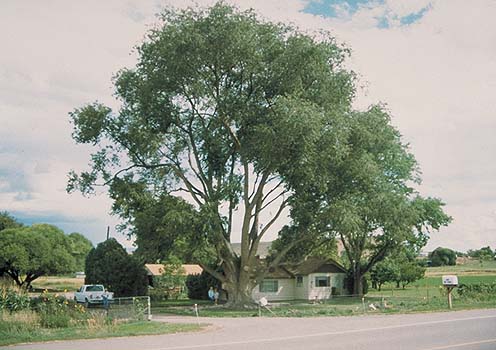
(The Siberian elm pictured here is a Colorado National Champion Tree that grows in Grand Junction.)

Park Service plan attacked


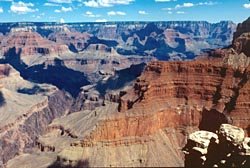
A coalition of environmental groups is working to silence the Grand Canyon. Rock the Earth is challenging the National Park Service's decision to allow motorized, commercial rafting tours and helicopter sightseeing trips to continue through the park.
The group's press release is on the Rock the Earth Web site. Rock the Earth and its environmental partners note that the presence of motorized boats and helicopters dominates the limited access to the Colorado River. They believe the ruling violates the National Park Service mandate that the Colorado River through the Grand Canyon be maintained as wilderness.

Tuesday, March 28, 2006

In search of single track, Moab style


There's a joke people in Moab don't often tell, but people in Colorado do:

Guy goes to Moab to bike, walks into the bike shop and asks, "Where's the best single track in Moab."
The bike shop employee says, "in Fruita."

OK, it's sort of an insider joke (Fruita is an up-and-coming mountain bike destination 100 miles away) - and even then it's not that funny - but it does have a funny truth in it: Moab has almost no single track. Almost all of its famous trails are old jeep roads.

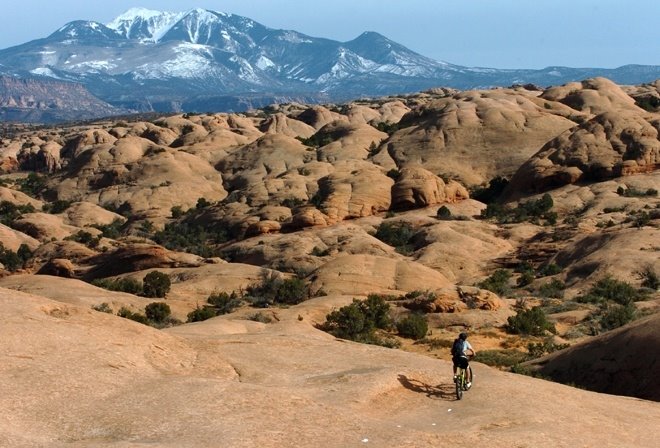
For years, the town has done nothing to change that, but about a month ago, it opened one of the first new single tracks ever in the area, and the first one designed specifically for bikes. The trail is called Baby Steps. We got a hand-drawn map from a local and headed out to check it out this morning.

I can't say enough about how good it is. We had about 8 miles of windy, tight single track mixed with another 10 of fun, incredibly scenic jeep road that had it all: wide open slick rock, fast, rolling hills, steep climbs, and a little bit of us getting lost (the hand-drawn map wasn't that good).

And here's the amazing part: It was the first time all week we were on a trail with no ATVs or dirt bikes. We didn't even see any other bikers. Right now this trail is a locals' secret, but it is worth blabbing about.

If you plan on a trip to Moab this spring, stay tuned to The Gazette's Out There sections (Fridays). I'll throw in all the info for the trail soon.

Because it's dawn


"Because it's there" is the answer British climber George Mallory gave those who wondered why he felt he had to climb the world's highest mountains.

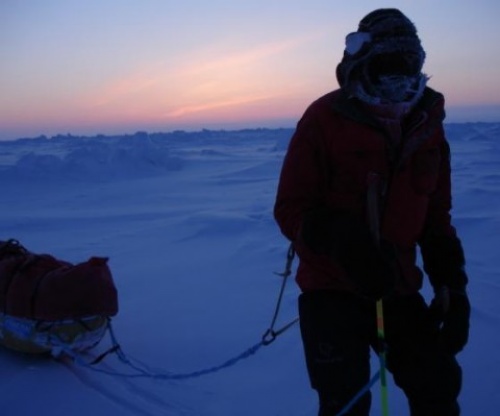
The reason behind a recent North Pole expedition is a little more poetic. South African Mike Horn and Norwegian Borge Ousland reached the North Pole last week. Why the Arctic, in winter? Because they wanted to see the sunrise from the North Pole.

The pair finished in 60 days and 5 hours. On day 59, Horn wrote on his Web site, "The Spring Equinox has arrived and the sun is in the sky 24/24. We didn’t realize that what we were seeing before was actually only the reflection of the sun. It wasn’t the sun at all. Now, after 3 months we are looking at the real sun and it is something different altogether. For the first time yesterday we saw shadows. You think you feel heat in the suns rays but in fact you don’t. It really is the most amazing sight.”

The story of the expedition is one of hardship - polar bear encounters, frostbite from temperatures as low as -40 degrees, and walking 620 miles without dogs to pull their sleds.

At the end, Horn wrote, "It's great to finally be standing on the North Pole. This mystical place is all that it is made out to be. It's incredible out here!!"

Oil and gas lease sale

Mountain bikers and black-footed ferrets won't be
pleased with this news: The Grand Junction Daily Sentinel reported today that land on the Grand Junction side of the Bookcliffs will be auctioned in an oil and gas lease sale in May. The 45,721 acres in Mesa County include popular mountain biking trails. In Moffat County, 119,000 acres have been marked for development as well, including part of the Wolf Creek Management Area, where nearly 200 endangered black-footed ferrets have been released since 2001.

Riding Petrified Clouds


Yesterday, photographer Christian Murdock and I rode Moab's famous Slick Rock trail. And this morning, even after a strong coffee, I realize there is no way to describe it that doesn't make me sound like the hack leaflet author whose work covers fliers on the walls of every business in town.

But, hey, really, the only obvious difference between a leaflet writer and a newspaper writer is the quality of paper, so here goes:

Slick rock is a truly unique place. And I don't mean "huh, this is different." I mean "there is nothing like this in the world."

When I was young, I used to look up at the puffy cumulous clouds on summer afternoons and dream about being able to walk along the surface, exploring all the rounded swales and towners. Slick Rock is like one of those clouds petrified. The trail rolls over domes and long sandstone fins, rarely touching dirt.

It hugs cliffs and swings riders out to unexpected views where suddenly, turning a corner, the Colorado River is right there, slinking through a canyon as slow and muddy as the Mississippi.

It's no wonder when Mountain Biking magazine first wrote about this trail (originally built by motorcyclists) in 1986, it put Moab on the map as a mountain biking Mecca.

Yesterday, true to its reputation, the trail had probably 100 riders on it. The parking lot was full. Sometimes on narrow parts of the trail, we had to wait for groups to go by. Not that we weren't happy for the rest. This long, up and down trail could easily handle twice as many riders, and does on peak weekends.

This morning, we're trying something new. The locals just finished building the first new trail in years, a scenic single track called Baby Steps. We're on our way to check it out. Look for the report here this afternoon.

Monday, March 27, 2006

Way to go!

Two local athletes have been nominated for an Everest Award, the outdoor industry's most prestigious honor. Nancy Hobbs and Matt Carpenter have been nominated in the trail runner category. According to the Teva Mountain Games Web site, the awards are "given annually to the top male and female athletes whose skill and innovation has pushed their sport to new heights and redefined the parameters of the achievable. They are pioneers, innovators, leaders, change agents and reflects the soul of the sport."

That pretty much sums up the running careers of Hobbs, a veteran race organizer, runner and writer, and Carpenter, who holds the record for both the Pikes Peak Ascent and Marathon. The winners will be announced at a ceremony June 3 in Vail.

Favorite quotes from these guys:

From Carpenter's inclineclub.com Web site, about when he started running and why: "When I moved to Mississippi I started running because I had nothing else to do. I had always played in the band and it turned out because of a scheduling conflict I had to drop band to take chemistry. Soon after I heard an announcement to try out for cross country. I did because I thought they really meant I would run across the country!"

From Hobbs' bio on the same site, about when she started running: "Sometime in high school because my father started running and I wanted to see how far I could run."

Sure signs of spring skiing

From the eyes of Gazette editor Joanna Bean:

1. The parking lot is full but the slopes are deserted. The patio at the base lodge? It's packed.
2. The lift attendants are crabby. Or giddy.
3. On the drive home you see kayakers pulling out of the river.
4. The sun is still overhead while you're soaking in the creek-side pools at Mt. Princeton - even though you caught the last chair up at Monarch.

Mad about Moab


I'm at the corner of Main and Center Streets in Moab, Utah, watching one car after another cruise past with full racks of bikes, bound for the red desert beyond. It's 60 degrees. The flowers are opening on the cherry trees in town. Spring riding season is in full effect.

This morning, after sleeping out on a gorgeous bluff in the desert where the stars were so bright I had to bury my head in my sleeping bag, photographer Christian Murdock and I rode the 14-mile trail/road to Gemini Bridges, a natural sandstone bridge spanning a dark, echoey canyon.

We weren't there five minutes when about 10 trail bikers pulled up. Then three more. Then four more. Then an old couple with a fancy (but dumb) dog that almost fell in the canyon. Then a mom mountain biked in with her kids. "No, don't throw M&M's down in there" she said. And then the kids did anyway when her back was turned.

This is all just to say that Moab is a wonderful place, but if you take some of the easier, more accessable roads, like the one to Gemini Bridges, you should expect to have some company.

We're here on assignment for two more days. We'd love any hints about what not to miss.
Click below to tell us about your favorite places to ride and eat.

Not lovable Bullwinkle

Warning to moose: The Colorado Division of Wildlife won't tolerate bad behavior. Warning to people: Watch out for moose.
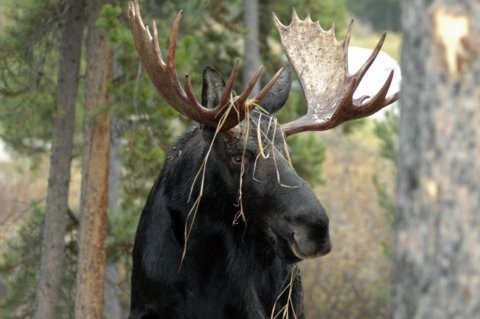
On Sunday, a bull moose attacked and seriously injured an elderly resident of Grand Lake who was walking to church. The moose was shot and killed after the attack. "All indications are that the moose attack was unprovoked," said DOW regional manager Ron Veldade. "The DOW will not tolerate wildlife aggression towards people and in this case we felt fully justified in killing the moose."

Another attack by a moose was reported two weeks ago: A moose knocked a woman to the ground and stepped on her after it was startled by her dog. She wasn't seriously injured.

Moose encounters aren't that rare. I know a wildlife photographer who has spent time in Alaska photographing grizzlies and wolves but who had one of his scariest encounters when a moose charged him. A friend in Winter Park was jogging with her dogs near the river, and was charged by a moose. I've been lucky: Both times I met moose face to face on a trail (in the Grant Tetons and in Rocky Mountain National Park near Grand Lake), I walked away. Luckily, the moose I met were preoccupied, munching on lush green willows.

So, if you meet a moose, what do you do? These tips are from Alaska Fish and Wildlife Protection:
1. Never get between a cow and her calf.
2. Never throw anything at a moose.
3. Keep dogs under control on the trail.
4. Avoid moose that are in a fenced area or place where they might feel cornered.
5. Step behind a tree if a moose charges.
6. If a moose charges, raise your hands over your head and spread out your fingers. Hold your arms still.
7. If a moose attacks, fall to the ground, cover your head and stay still.

Springtime in the Rockies


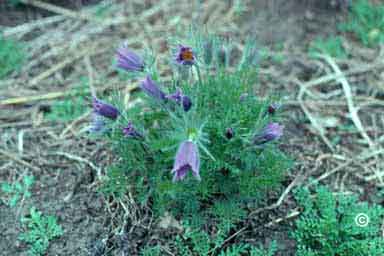
Coloradans know that it's not really spring until the pasque springs. That's in the pasque flower. Folks at Starsmore Discovery Center in North Cheyenne Canyon park, say it's happened. The delicate-looking lavender flower has been spotted on Upper Meadow Loop.

Friday, March 24, 2006

My little slice of heaven


Here's your bit of trivia for the day. Use it like this to impress your friends at your next party:
Did you know there are 507 million acres of public land overseen by the Department of the Interior (including the National Park Service and the Bureau of Land Management)?
And follow up with this: That's one out of every five acres nationwide.
And this: That's about 1.7 acres for every person in the United States.
(That's my 1.7 acres, at right - in Rocky Mountain National Park.)

Advertising on public land?


The Forest Service is considering changing the rules for advertising on public land. Right now, almost all advertising is banned, but ski areas (most of which lease land from the Forest Service) have been pushing for rules that let them advertise to skiers and snowboarders on chairlifts. Think placards on lift poles, etc.

People have until Monday to comment on the rule change.

If you want to let the Forest Service know what you think about billboards at ski areas, send a letter to USDA Forest Service, Attn: Carolyn Holbrook, Recreation and Heritage Resources Staff (2340), 1400 Independence Ave. S.W., Stop 1125, Washington, DC 20250-1125. Or send a fax to Holbrook at 1-202-205-1145, or an e-mail to rhr2300@fs.fed.us.

What's Silverton Mountain Really Like? Take a look:

There's so much talk, and so little actual information about Silverton Mountain for two reasons, I think. First, this epic quiver of steeps and chutes has only allowed 80 skiers a day, so very few people have actually been there. Second, those who have been, can't help but turn it into a fish story, where the runs get steeper every time they tell the tale. So what is it really like? Photographer Christian Murdock and I were there in late January. Have a look at what we saw.

Silverton Mountain opens unguided skiing March 31. Now it's your turn. Have you been to Silverton? What tips do you have for people who might go?

Thursday, March 23, 2006

Pay to play?

I know people who live near Mueller State Park who haven't been inside its boundaries since it was opened. The reason: They won't pay to visit a place they used to explore free of charge.

Whether to charge or how much to charge is a dilemma faced by many states. Most states, like Colorado, rely on fees to help pay the bills.

On Monday, officials in Washington took a step in another direction, removing the $5 day-use parking fee from all state parks. They said attendance at many parks dropped dramatically after the fee was imposed. Officials there are optimistic attendance will increase in the 120 state parks now that entry is free again.

Rocky Mountain fever


Maybe it's just a coincidence, but with all the wildlife getting attention in New York City - falcons nesting, coyotes running - it seems like New Yorkers are just a little jealous of what we have in Colorado.
Case in point: Aspen, a new restaurant/club on W. 22nd Street, that city bloggers are touting as the hottest place to be seen. Reports are that Aspen has an over-the-top ski lodge decor, complete with a foggy forest, an aspen grove, and deer heads made of Lucite (it is New York, after all).

Waiting, waiting, waiting

The waiting list for people who want to raft the Colorado River is legendary, with some people waiting as long as 10 years for the chance to put their raft into the water. That could change with a plan just approved that allows more people to float through the Grand Canyon each year, but spreads out the trips over more months and in smaller groups.
The approval of the new plan, announced by the National Park Service, has also been a years-long process itself. Four years ago, a group of scientists, park officials, tour operators, and members of American Indian tribes and the public began studying usage plans:

PHOENIX (AP) — A plan that allows more people to float down the Colorado River through the Grand Canyon each year but spreads them out over more months and in smaller groups has been adopted by the National Park Service.
The new Colorado River Management Plan also eliminates the current waiting list for those who want to raft the river in noncommercial boats, replacing it with a lottery system. Many people sat on the waiting list for more than a decade, and the lottery will give them some preference but does not guarantee them a slot.
The plan will shift more travelers into the fall, winter and spring months, while cutting the number of daily summertime launches of both motorized and nonmotorized commercial rafts in the upper Grand Canyon.
The result would be more tourists overall. The lower Colorado River, from Diamond Creek to Lake Mead, will see the number of pontoon boat tours go up, allowing up to 480 passenger per day, up from the current 130 passengers. The plan bans jet boat tours entirely, but commercial operators that use the craft to meet rafts above Lake Mead would still be allowed.

For more info, go to http://www.nps.gov/grca/crmp/

A new beginning?


It's called delisting, and yesterday, the Wildlife Society endorsed it. A release sent by the National Wildlife Federation announced the organization believes grizzly bears in the Yellowstone ecosystem should be removed from the threatened and endangered species list:

Missoula, MT (March 22) – The nation’s largest organization of professional wildlife scientists has endorsed the removal of grizzly bears in the Yellowstone ecosystem from the nation’s list of threatened and endangered species. The Wildlife Society, comprised of nearly 7,000 individuals nationally, is joined by its Montana, Idaho and Wyoming chapters in supporting the delisting of Yellowstone’s grizzly bears.
The Wildlife Society’s position statement calls the grizzly recovery effort “a model for how cooperative efforts by state and federal resource management agencies can lead to the recovery of a listed species.” The Wildlife Society statement is particularly important in contrast to a recent letter signed by some scientists who oppose delisting.
In November, the U.S. Fish and Wildlife Service declared Yellowstone grizzly bears recovered and proposed plans to remove the bears from the Endangered Species Act’s list of threatened and endangered species. The Wildlife Society has chosen to endorse delisting because it found that population abundance, distribution, and mortality targets established in the Grizzly Bear Recovery Plan have not only been met, but “far exceeded targets in the recovery plan.”
According to the Wildlife Society:
- From an abundance standpoint, the goal of observing at least 15 different females with newborn cubs per year (based on a six-year running average) across a standardized counting area consisting of the recovery zone and a ten-mile perimeter was met every year since 1986. Extrapolating from the number of females with newborn cubs observed during 2004, the total population was estimated to be 588 bears using the methods of Keating et al. (2003). This estimate is greater than twice the population of 250 bears calculated at the time of listing in 1975.
- The annual distribution target (i.e., at least 16 out of 18 of the recovery zone's Bear Management Units must be occupied by observed females with offspring over a six-year running sum) was exceeded every year since 1998. During three of these years (2000-2002), females with offspring were observed in all 18 Units.
- Mortality of females aged two years of age or older, from all causes including estimates of unreported mortality, has been below the current threshold of no more than 9%.
“Grizzly recovery efforts have been under way for more than 20 years,” says Tom France, Director of the National Wildlife Federation’s Northern Rockies Natural Resource Center here. “Leading bear scientists helped develop a bear recovery plan with specific recovery goals. These recovery goals have undergone extensive public review, and have been ratified by the courts.”
The Wildlife Society statement notes, “the current level of recovery in Yellowstone was achieved through the active collaboration of state and federal resource management agencies. The continuation of this fruitful collaboration may be jeopardized if unattainable recovery targets are substituted for realistic and pragmatic ones.”
“We have been involved with grizzly recovery every step of the way, including development of quantifiable recovery goals,” says France. “Over the last two decades we have leaned hard on both federal and state agencies to ensure these goals were met. Now we feel a deal is a deal. It would be wrong for us to try to raise the recovery bar now that goals have been met and exceeded.”

Snow-free hiking for this weekend.


It's warming up fast and this weekend is supposed to be a beautiful, but that doesn't mean the trails are dry. Even though the snow is almost gone in town, the foothills got much more moisture from the last storm and have managed to hold onto the ice because it's been so cold.
So....
If you want to get out and enjoy a sunny afternoon this weekend, take these trails instead:

Aiken Canyon -- An awesome four-mile loop through a nature preserve southwest of town.

The Paint Mines -- Not truly a hike, but a neat place to go mess around near Calhan.

Tunnel Drive -- An old railroad grade (pictured above) running from Canon City into the Royal Gorge.

Or, how 'bout taking a spin on Colorado Springs sprawling network of urban bike trails?

At peace on the nest


Pale Male, the red-tailed hawk that lives on a ledge above Fifth Avenue in Manhattan with his mate, Lola, continues to hunt pigeons and rats in Central Park to bring back to the nest, where Lola patiently sits on the couple's eggs. Yesterday, some stunning photos were posted on Palemale.com of Lola on the nest and Pale Male bringing home dinner.
The photographer writes that he is amazed at the peace Lola seems to exude, even with all the madness of the city blaring around her.
It's amazing these birds are back. Just last year, the rich residents who own their apartment ledge removed their nest. It was only after editorials in the New York Times and days of protests in front of the building that the birds were allowed to stay.
The hawks mated in early March, which means their eggs could hatch near the end of April. Keep watching.


And speaking of critters in Manhattan. More news of the coyote captured in Central Park yesterday. Given the name Hal, after the Hallett sanctuary in the park where he was first spotted, he isn't the first coyote to turn up in the park. In 1999 a coyote named Otis showed up. He now resides in the Queens Zoo.
City wildlife officials speculate that coyotes live full-time in the Bronx, just northeast of Manhattan, and Coyotes may actually have dens in Manhattan. For more photos of Hal, click here

Wednesday, March 22, 2006

Bright lights, big city


How did a coyote get to New York City's Central Park Wednesday? An AP story has officials saying "the animal may have wandered into the city from suburban Westchester County, or perhaps crossed the Hudson River from New Jersey via a bridge, a railroad trestle or a passing truck."
We like the passing truck theory, in which the coyote (wily, of course) stows away in a truck, in hopes of making it to the big city.
The coyote, nicknamed Hal, was captured close to 79th Street and Central Park West, after he was shot with a tranquilizer gun. He will be taken to a wildlife center outside the city.

You've never tracked moose like this...

Web-savvy wildlife watchers can track the movements of two female Shiras moose captured in Utah and released on the Grand Mesa in January.
The girls are fitted with special telemetry collars that send a GPS signal to satellites. The data is sent back to computers on Earth to allow biologists – and anyone who has Internet access – to track the moose.
To see the tracking information, go to the DOW Web site.
Speaking of online wildlife, the owls at the owl cam are still there and - surprise - they are alseep right now.

Now we're talking


You've just finished a rigorous workout and you reach for a sports drink. You know, the kind that comes in red or blue or green and says it replenishes all the fluids and some important nutritients that left your body while you sweated and strained. A physiologist at Indiana University Bloomington believes you should rethink that sports drink choice. His suggestion: chocolate milk.

Joel Stager, a professor of kinesiology, has found that drinking chocolate milk is the best way to recover after a workout. It has a high carbohydrate and protein content and replaces fluids lost as sweat. Stager first tested his chocolate milk theory on swimmers, and the promising results led him to conduct a study with cyclists in a more controlled environment. He said chocoloate milk is most beneficial to such athletes as swimmers, long-distance runners and cyclists. Wonder if you could substitute a hot-fudge sundae?

Cheap skiing at Wolf Creek


If you read my breakdown on the cheapest spring skiing and saw the mention of Wolf Creek's Local Appreciation Day where you can ski for $23, ignore the date.
The real date for the last locals day is March 29. And the Wolf has lots of snow, so it might be worth checking out.

Who's reading this blog?


We have a tool here in the newsroom that lets us see how many users view this site, when, for how long and, most interesting to me, where they navigate from to get to our page.
Most of our visitors come from gazette.com, or our excellent Out There Web page, outdoors.coloradosprings.com.
But some people end up here after searching on Google for phrases like "skier, tree" or "Iditarod, Colorado."

The most recent search was "Fourteeners, Jesus."
I'm thinking this guy was a local.

To see the Google results of this search, click here.

A tour of the burrow from the BLM

B
The Bureau of Land Management has started a cool occasional online series called "Road Trips."
The monthly e-mails highlight a program or region of the state that the BLM works with. And it's not the typical "been there, done that" stuff you find in most fliers.
This month, the road trip gives a detailed tour of the Black-Footed Ferret reintroduction program in northwestern Colorado. To see it, click here . Generally, the tour is pretty good. It tells readers the history of how the ferrets grew from a wild population of just 18 in 1985 to a meticulously managed population of about 1,000 today.
It does leave out that Colorado's population has had almost no success in reaching the goal of a reproducing wild population, but it does give readers links to some good ferret-centered nonprofits that offer more info.
You can see the latest road trip at www.co.blm.gov.

Tuesday, March 21, 2006

An ode to winter

It's spring, and the snow is leaving the foothills. Soon, it will be gone from the mountains. As a fond farewell to a memorable winter, I offer up this excerpt from one of naturalist and Rocky Mountain National Park advocate Enos Mills' essays called "In a Mountain Blizzard". In this essay, Mills, who frequently sought out the barren summits of peaks along the Continental Divide, tells about a battle he and his dog Scotch waged to survive a blizzard:
"At last I realized that I must stop and spend the night in a snow-drift. Quickly kicking and trampling a trench in a loose drift, I placed my elk-skin sleeping-bag therein, thrust Scotch into the bag, and then squeezed into it myself. I was almost congealed with cold. My first thought after warming up was to wonder why I had not earlier remembered the bag. Two in a bag would guarantee warmth, and with warmth a snow-drift on the crest of the continent would not be a bad place in which to lodge for the night."

Back to the beginning


Here's a trivia question for you: Which Colorado ski area hosted the first snowboard competition?
(Bonus question: What year was it?)
If you remember the contest at Ski Cooper, you're right. If you remember the year, you're really good. If you were there, you're old!
In 1981, Cooper opened its slopes to a strange and virtually unknown competitive sport - snowboarding. To commemorate the silver anniversary, Cooper is hosting "Return to King of the Mountain," a celebration of the sport that transformed ski resorts. The event will feature legendary snowboard pioneers competing on antique equipment furnished by Burton, Sims and Winterstick. There's also a rail jam open to the public, and live music. Check it out April 1 (closing day) at Cooper.

Hot Wheels


I just paid a visit to USA Cycling and got a chance to see what the U.S. team mountain bikers are riding in 2006, and it's hot.
They're on the Specialized S-Works bike: a carbon frame, disc brakes, top-of-the-line components and the most awesome rear suspension I've ever tried. The new Brain shock automatically adjusts the suspension from firmly efficient in smooth terrain to fully active in the rough stuff. Most of the time, it feels like it's a hard tail, but get into the rocks, and it immediately softens up. Very, very cool. And light, and responsive -- a race horse.
I was lusting after it. I was even thinking of turning in my old Univega.
Then I saw the MSRP: $7,800.
Wow. Too close to how much I paid for my car.
Can anyone recommend a good, all around bike that is a good value?

What are these guys learning at CU?

The Rocky Mountain News had a story today detailing how four guys from CU got lost while snowshoeing on Mt. Princeton.

These guys did just about everything wrong: They wore all cotton in a wet snowstorm; they left the trail to find a "short cut" down; they split up.

They were rescued at about 11 p.m. after calling search and rescue on a cell phone.

The rescuers said the hikers were aloof and expressed little gratitude. But the father of one young man later said the hikers would say thank you and send a hefty donation to search and rescue.

Anyone looking for basic advice before heading into the backcountry could do well reading a Gazette article with Colorado Mountain Club trip leader Bill Houghton. In short, be prepared.

And should you need help, always thank your rescuer.

Coalition Building


The head of the Nature Conservancy in Colorado, Charles Bedford, had an op-ed piece (posted below) in The Gazette today lauding a new $7 million buffer zone around Ft. Carson. Turns out, what's good for artillery ranges is good for Bambi lovers too.

The problem for the fort was this: The exurbs of Pueblo West were creeping in on the southern flank. Battalions of doublewides, each on about five acres (none with any water), had taken a position on the eastern front. I was doing trail work with a young captain one day last summer and he was grousing about the doublewide residents complaining every time the practices at Ft. Carson's gunnery range got too spirited. According to him, people even had their windows blown out.
What could Ft. Carson do? It's not going to stop lobbing shells, so it started buying people out to create a strip of undeveloped land around its proving grounds.

It turns out this strip is critical for the Nature Conservancy's master plan to maintain an undeveloped corridor on the rapidly urbanizing (or at least suburbanizing) Front Range. The group already owns the 41,000-acre Bohart Ranch southeast of Colorado Springs, which links up with two other conservation-minded ranches to the west, Chico Basin Ranch and T-Cross Ranch. These lands connect with Ft. Carson. On the west side of the post, the Nature Conservancy owns the 1,600-acre Aiken Preserve. The preserve connects to the Pike National Forest.
Together, these properties form a strand of undeveloped land stretching from the low cholla cactus flats to the icy alpine summits, creating a corridor in which animals can travel relatively freely.

So, everybody wins. Well, everybody except the people who didn't want to move out of the buffer zone.

The thing about this that I think people often overlook is that in this military town, the military bases act like open space buffers already. What would Colorado Springs look like without Ft. Carson and the Air Force Academy acting like bookends? It's not a pretty picture.

The guest commentary by Charles Bedford:
Fort Carson buffer zone a Boon to region
By CHARLES E. BEDFORD THE NATURE
CONSERVANCY OF COLORADO
The Army’s recent allocation of an
additional $7 million to conserve buffer zone lands around Fort Carson will
protect not only our country’s military preparedness, but also our state’s natural heritage. The leadership and vision exhibited by U.S. Sen. Wayne Allard, Rep. Joel Hefley and the Army have begun a stream of financial and community support to an effort that ultimately will safeguard the open space and beauty of this region. Rapid urban development and loss of natural areas around military bases across the country pose a growing challenge to both military training needs and the conservation of significant wildlife habitat. As housing and other human development creep closer to military base borders, restrictions are often imposed on military activities, which can undercut the realism and effectiveness of training. This rapid development also poses an obvious threat to the relatively undeveloped lands surrounding Fort Carson, including land that is critical for four rare plant species that are found nowhere else in the world. In addition, species of concern such as the
mountain plover rely on the area for habitat. Mexican spotted owls, ferruginous hawks and herds of elk and pronghorn also depend on these lands. Fort Carson is in the bullseye of development pressures. In the last decade, the population of Colorado Springs has grown 30 percent,
topping a half-million and making Forbes Magazine’s list of “Steroid Cities.” As Colorado Springs continues to invest in its growth, we must also invest in preserving the open spaces and diverse wildlife that make Colorado such wonderful place to live. Under the Department of Defense
buffer program, the military, state and local governments, conservation groups, and landowners are all working together to protect training, quality of life, traditional lifestyles and natural resources. Activities involving private land are undertaken with the full endorsement of willing landowners.
In these days of fiscal constraints and increasing conflicts over land use, a policy that accomplishes multiple public benefits with one action and that is based on cooperation and collaboration rather than conflict deserves everyone’s support — and certainly has ours. While Allard’s and Hefley’s leadership has allowed us to make great progress, there is more work to be done. Only about half of the land in the buffer zone around Fort Carson is now protected under this voluntary collaborative partnership. We’re at the 50-yard line with a long way to go. But with the leadership of our legislators and the Army, and the support of willing landowners seeking to preserve their way of life and of the local community, we know we can go the distance. Building on this momentum, The Nature Conservancy of Colorado has launched the Peak-to-Prairie Project in partnership with Colorado Open Lands and the local ranching community to protect a landscape stretching east from Cheyenne Mountain to the Chico Basin and Bohart ranches, knitting together a series of protected lands and preserving open spaces between Colorado Springs and Pueblo. Neighboring ranchers are a critical part of the buffer effort. The shortgrass prairie ecosystem needs large, unbroken landscapes to thrive, and ranches provide some of the best remaining large
examples of this system. Sustaining wildlife and our agricultural heritage go hand-in-hand. Ranchers, military staff, public agencies and local people are coming together in an unprecedented way to make this a very exciting, crucial time for the region. What we do today will determine what this
landscape will be 10 years from now. Here, now, there is the chance to protect huge parcels of land owned by just a few people. In a very real sense, the team effort will define the future of this community. It’s no wonder Fort Carson is becoming a model throughout the country for how to use buffer zones to enhance wildlife and quality of life while preserving traditional lifestyles and military needs. The Nature Conservancy stands with so many others in the Colorado community to say thank you to Allard and Hefley and to the Army leadership at Fort Carson and in the Pentagon for their stamina and wisdom in protecting the community values embodied in this special place. Bedford is state director of The Nature Conservancy of Colorado former director of the
Colorado State Land Board.

Monday, March 20, 2006

Psst. Fence. Pass it on

You love 'em or you hate 'em. We're talking prairie dogs. North of here, in the Boulder/Broomfield counties area, folks just can't agree about the little critters. So they're compromising by putting up a fence, according to an Associated Press story that moved this weekend. The 2,400-foot fence is supposed to keep the 'dogs on the Boulder side, where they are protected, and keep them away from the Broomfield side, where they are despised. Volunteers erected the fence out of chicken wire and pegs that they hope will keep the prairie dogs on the side where they are welcomed. Will it work? Boulder County wildlife biologist Mark Brennan explains that prairie dogs will walk until they reach a vertical barrier and then try to dig under it. A two-foot apron of wire is designed to stop them, but Brennan says the persistent animals will eventually find a way over, around or under the fence.

Banquet-bound?


Here's another reason to hurry your team of sled dogs along in the Iditarod - if you're slow, you might miss the banquet. The 2006 Finishers Banquet took place Sunday night in Nome, Alaska, where awards were handed out. Sixty-five mushers attended, but five others hadn't finished the race yet. (Note to Colorado musher-watchers: Bill Pinkham of Glenwood Springs came in 40th; Buena Vista's Lachlan Clarke finished 63rd of 83 teams.

Natural vs. Synthetic clothing


14er Skier Lou Dawson had an interesting post this weekend about the benefits of wool versus synthetic layers.
His take: both are good, but when it comes to a light, next-to-skin fabric, the new, soft wools win. They're warmer when they're wet, and can still stop the stink almost as much as an anti-microbial synthetic shirt.

A growing number of outdoor companies are going back to wool and wool blends, including, of course, Smart Wool, Ibex, Ice Breaker and Ortovox.

In the snow, a sign of spring

I was on a backcountry ski in Summit County Saturday when this current storm-system first moved in. A friend and I had skied to the top of 11,400-foot Georgia Pass. Just as we reached the top, the front of the storm hit. And even though it was snowing, we heard a sure sign of spring in the form of thunder grumbling up in the clouds. We didn't see any lightning. But the thunder cracked and echoed off the hills. It sounded like summer.
It won't be long now until all the snow, even in the high country, has melted away.

A big storm that was supposed to drop up to a foot of snow on Colorado Springs wasn't all it was cracked up to be. The north end of town and Woodland Park got about four inches, but the center of town got just enough to make it icy for the morning drive.
Yesterday afternoon, I was out walking with my wife in the sunshine, and she said, "You know, I hope it does snow really, really hard. I love those big storms."
And the snow swept in hard a few minutes later, but only lasted for about a half hour. Just enough to water my flowers... and freeze them.

Sunday, March 19, 2006

Space odyssey


Sure, there's new snow in the mountains. But that's not what I've been watching this morning. I'm checking out my favorite peak in a faraway place - Mars. The Gazette reported Sunday morning that Google has introduced its Mars mapping tool. The interactive site allows users to check out the red planet in three formats - color-coded by altitude, in black and white photos, and on an infrared map that shows temperature variations. So instead of watching our own mountains, check out Hecates Tholus, a bumpy little volcano that is about 18 kilometers high.

Friday, March 17, 2006

Division of Wildlife turns attention to gas drilling


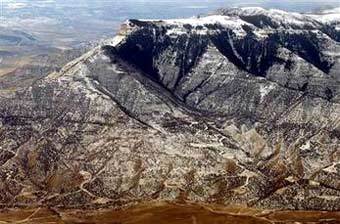
With gas drilling popping up across Colorado on places such as the Roan Plateau (left) at a never-before-seen rate, the state Division of Wildlife has added a special liaison to deal with wildlife related energy issues.

Here's the press release:

DOW HIRES LIAISON TO ASSIST WITH ENERGY DEVELOPMENT ISSUES
In the face of increasing energy development in Colorado, the Colorado Division of Wildlife (DOW) has hired an Energy Liaison to assist in outreach efforts with the energy industry and federal and state regulators.

Kim Kaal, a certified professional geologist, was hired to fill the energy liaison position and began work on Mar. 1. Kaal has served as an environmental consultant to the energy industry and was environmental coordinator for EnCana in western Colorado.

"Working for years in the energy industry, I've seen how balance can be achieved between energy development and wildlife," said Kaal. "This position gives me the opportunity to work with industry and provide methods and concepts that can be used to minimize impacts."

Kaal is stationed in the DOW Northwest Region office in Grand Junction. "Energy development in northwest Colorado is occurring in the same areas that are home to the largest migratory mule deer and elk herds in the nation," said Ron Velarde, northwest regional manager for the DOW. Velarde oversees wildlife efforts in nine counties, including Garfield County which leads the state in operating drill rigs and number of permits issued for new wells. The challenge of mitigating the impacts of energy development is not just limited to one area, which is why the energy liaison will serve as a statewide authority on the energy industry.

There has been increased natural gas exploration across western Colorado, including the HD Mountains of southwestern Colorado. Beyond the natural gas boom the state is experiencing, Kaal will assist DOW staff with preparing comments regarding efforts to mine Colorado's low-sulfur coal deposits, potential oil shale development, oil wells along the Front Range, increased emphasis on wind and alternative energy, and interest in the state's uranium deposits. "Having someone with Kim's expertise and knowledge of geology is critical for the DOW," said Velarde. "We have a great deal of biological knowledge, but industry speaks a different language. Kim gives us someone who can translate our message to industry and bring industry discussions back to our level. It's not an easy job, but it's an essential job."

The DOW has no authority over energy extraction but serves in an advisory capacity for many land use agencies and regulatory bodies. The DOW is statutorily mandated to protect and enhance Colorado's wildlife resource.

Skiing this weekend? Here's the conditions


Fortunately, this is the only green you'll see this weekend. The resorts still have great coverage. No grass sticking through in this state. Summit and Eagle counties both had more than a foot of new snow this week and cold temperatures have kept it in great conditions. All the ski areas are calling for a little snow this weekend, but not enough to make driving hairy.
The bottom line: You won't find epic powder but get out early and enjoy prime corduroy.

Spring Break breakdown


If you haven't noticed the huge number of white license plates heading up Highway 24, spring break is in full effect at the ski resorts.
That means long, sunny days, corn snow, and lots of free entertainment on the mountains.

Here's a run down:

Vail has Skiing magazine's top-rated spring break party with its "Spring back to Vail" featuring huge free concerts (last year was Snoop Dog, this year's headliner hasn't been announced), an expanded amount of open terrain and the World Pond Skimming Championships. Check www.springbacktovail.com for details.

Breckenridge has the Spring Massive, with slopestyle and rail jam competitions for jibbers, and Breckenridge Bites, a townwide festival (April 1 -23) that allows diners to sample a three-course meal at participating restaurants for $15-$25. The season ends with two local traditions: the Imperial Challenge, a bike, hike and ski race up and down Peak 8, and the Bump Buffet, a telemark bump contest with lots of attitude and canned beer.

Copper Mountain has live music every weekend in April for its Sunsation fest, including everyone from reggae party standard Toots and the Maytals to Malian fusion rocker Toubab Krewe.

Winter Park's Spring Blast (March 25-26) will feature free music by Velvet Love Box, a rail jam, and free clinics on bump and tele skiing.

Echo Mountain Park has night skiing for $10!

And of course, no special events needed, the Arapahoe Basin beach scene is in effect.

Don't forget your sunscreen.

Thursday, March 16, 2006

Incline times: what means what?


Let me just throw this out there, with the understanding that the Manitou Incline lies partially on private land, and hiking it is trespassing:

How do your tresspassing times compare with others?
This is just a rough list. Please comment below and we'll adjust it:

If you can do it in...

One hour, you're slow, but deserve respect for doing it at all.

50 minutes, you probably didn't stop to rest, even though you wanted to. Good job.

40 minutes, you move slow and steady. You're probably an incline regular.

30 minutes, you probably run races on the weekend for fun.

25 minutes, you probably come close to winning races on the weekend for fun, and pass everyone else on the incline.

20 minutes, you are one of the elite athletes in the city.

18 minutes, you are Matt Carpenter (when he still did the Incline) i.e., you are the fastest hill climber in the state, if not the whole country.

Motorcycle diaries


Mike Jacobs just finished a motorcycle trip from his home in Black Forest to Tierra del Fuego on the southern tip of Argentina. Now he's riding back.
He's keeping a great
online journal.

Some of the choice entries I found in a quick glance include this one:


Ride from Popayan to Ipicles, Colombia

Welcome to Switzerland without the snow. My partner Luis agreed the country side and the views were Switzerland. Only the buildings were Latin America.

Most of the towns were picturesque with different color row houses and shacks.

Interesting sights and events were
1. Beautiful waterfalls;
2. Riding the mountain ridge line and overlooking two deep valleys by just turning my head 180 degrees,
3. Seeing bicyclists hitching rides up the hills by hanging on the tailgates
4. Rivers far below in the valley.
5. Meeting an Italian bicyclist riding from Mexico to Peru. At the time he was repairing his inner tube.
6. Washing the bike for about on hour.
7. Finding an altitude of almost 11,000 feet where it was 62’F.
8. Changing temperature from 100° F to 53° F in Ipicles.
9. Challenging the army on a bridge! The army has soldiers stationed at most bridges in Colombia. On a very long bridge I stopped in the middle to take a photo. The soldiers at both ends started waving at me and were coming at me. I took my photo, and started rolling again and showed the camera as I blew past the guard. He waved back.

From Popayan to Ipicles, Colombia was another fabulous ride through the mountains. The road was mostly maintained but had about 100 miles of needed repair.

I bottomed out the kickstand once. Also was very careful on the mud covered spots in the road.

Guards about every twenty or more miles.

We bargained the Hotel Mayasquer ‘down from $20 pp to $ 10 pp. This hotel is 300 feet from the Ecuador border and we walked it. It is a Travelodge and we were the only guests. They locked up our bikes in a garage attached to the hotel so we could walk to them inside. Address Avenida Paramedical Km 3 Via Rumichoca,phone 7734062, http://www.klrog.com/JournalofTierraDelFuegoTrip.html

Luis found out he needs a visa to get into Ecuador. Tomorrow will find out his entry.

Note 1. Technical
Popayan has two Kawasaki dealers. I know this because stopped I stopped at the first and Asked for a speedometer cable. They called the second one and within minutes I had a replacement delivered to me. Cost $ 8. Try that in the U.S.

Note 2. Army guards and police.

I drive by all checkpoints at about 60 mph while also passing cars and trucks who slow down for them. So far all I get is a wave, thumbs up, or a whiplash head turn.

This has been my practice in all countries.

So far, no high speed chases or gunfire.

There are no speed limits for motorcycles. They figure most bikes can’t speed.

Also motorcycles do not pay tolls in Colombia. There is a special 2-foot-wide bypass with ropes at both ends.

Miles: 215
Food $1, gas $6, lodging $10


By the way, I don't have any pictures of Jacobs on his motorcycle, (the one above is an actor portraying Che Guevara) But you can see pictures of Jacobs here.

Wednesday, March 15, 2006

Over 1,151 miles later, Iditarod is over


Well, at least it's over for the winner, Jeff King.
Local musher Lachlan Clark, who lived for several years in Colorado Springs and now lives near Buena Vista, is in 52nd place and still has 200 miles to go, according to the Iditarod Web site.

Old skiers usually have beards


Women live longer, but men ski longer. At least, that's what studies suggest.
According to a story in the Vail Daily "Research by the National Ski Areas Association shows that women make up a declining percentage of skiers as the population ages beyond 40. At age 40, women make up just under 50 percent of skiers. At 47, women make up 40 percent of skiers and snowboarders, and by 67, just over 30 percent of skiers and snowboarders are women."

Why? The study cites possible answers, such as that women like to ski in groups, and as fewer and fewer are able to ski, they discourage women still in skiing shape. I'm sure there are a number of other factors.
I will say, though, that I know at least four women over 60 who are better skiers than I am. And I'm happy they still hit the slopes, because they're usually willing to give me some pointers.

Tuesday, March 14, 2006

What choo talkin 'bout


The storm has cleared in the San Juans, the sun is out, and Wolf Creek has reported 104 inches, which is exactly two Gary Colemans stacked on top of each other.

The challenge of owning Silverton Mountain


I just got off the phone with Jenn and Aaron Brill, who own Silverton Mountain. They are in the midst of getting ready to open the mountain to unguided skiing March 29.
But right now, they have a more pressing problem. One of their resident lodge dogs that lie around by the wood stove recently got a blockage in his intestine and almost died. The vet said it may be caused by stress.
Since the Brills noticed the dog trembles at the sound of avalanche blasting, they figured the blasting might be causing the blockage. Unfortunately, there's no shortage of blasting, both at Silverton Mountain, and around the town of Silverton, so the dog is wreck.
The Brill's solution? Whenever blasting is about to start, turn up the volume on the radio to drown it out.
This morning, while on the phone, I could hear the satellite radio hip hop station blasting.
Apparently, the dog finds the beats quite soothing.
Word is bond.

"Just prairie"


The Gazette business section reported today that a 1,200-acre swath of city-owned land south of the airport will soon be transformed into a business park that will bring "4,000 to 5,000 new jobs" to an area that is now "just prairie."

The story details the kinds of businesses moving in, when work will start, and what the business park means to the local economy.

But have we, as a community, examined what we'll lose?

While some people see the area as "just prairie," others have been fighting to protect this land. The dispute has pitted city residents, and even city departments, against the city-owned airport over the best way to use public land.


What's at issue? The land holds a rare concentration of native short and tall prairie grasses including blue stem, blue grama and buffalo grass. Some have said it is the highest quality swath of prairie east of Colorado Springs. It has almost no invasive species, and the diversity of local grasses, forbes and wildflowers is impressive.

According to the Trails and Open Space Coalition:
In 2002, the Colorado Natural Heritage Program released a report describing unique conservation areas in Colorado Springs. Regarding the airport prairie, it states "Very few large patches of tallgrass prairie remain in Colorado. The Colorado Springs Airport encompasses the largest known occurrence of a big bluestem - prairie sandreed tallgrass prairie in Colorado. The community is most extensive within about two square miles south of the airport between Drennan and Powers roads and occurs in small patches within surrounding areas. The TOPS Working Committee resolution passed a resolution in 2001 stating that the airport prairie "provides majestic views of the front range, Pikes Peak, and the Spanish Peaks, affording a unique sensation of spaciousness and solitude despite its proximity to its urban and airport surroundings."

The richness of the area is not lost on the local inhabitants. A herd of perhaps 20 antelope, along with foxes, badgers, coyotes, jackrabbits, hawks, falcons and other prairie creatures thrive on this patch of land, which is adjacent to the city's Bluestem Open Space.

For about 10 years a group called The Airport Open Space Advocates has been trying to convince Colorado Springs Airport officials to protect a part of the biggest open space parcel in the city of Colorado Springs. It was all part of a grand plan to make a 6,000-acre wildlife/park corridor joining the airport open space, the Bluestem Open Space across the road, Fountain Valley School's large fields, and Fountain Creek Regional Park.

What do you think is the best use for this land? Airport business park or open space and wildlife corridor?

To learn more about the open space effort,
click here.

Monday, March 13, 2006

Wolf is howling

I drove over Wolf Creek Pass this afternoon on my way to Mesa Verde, and was amazed by the crowds. Drive past Wolf Creek Ski Area on any given Monday, and you might see a half-full parking lot and wide-open trails. But the Wolf just had one of its best snowfall weeks of the season, and today the parking lot was full and both overflow lots on the east side of the pass were full. It was snowing seriously (are there ever just flurries on that pass?), and the locals and spring breakers were taking full advantage of the conditions. Down here in the Four Corners area, there's a blanket of new snow on the ground, but not enough to mask the features of the Sleeping Ute Mountain.

Crowded slopes


If you've been noticing the slopes are a bit more crowded this year, you're not alone. In fact, you're not anywhere close to alone.

The lastest numbers just came up from Colorado Ski Country USA. Here's what they said: In total, Colorado resorts hosted more than 5.2 million skiers and snowboarders from Jan. 1, through Feb. 28, 2006, an increase of more than 5 percent, over the same time period last season and more than 230,000 visits ahead of its previous best period (during the 2003-04 winter season).

No more blue bus!


Breckenridge is building a new gondola (or gon-DOLE-a, for you Texans out there) that links the mountain with downtown.

According to the Rocky Mountain News: Breckenridge Ski Resort and the Town of Breckenridge announced that construction of a gondola from the town to the resort will start this spring.
The new gondola will start from the Breckenridge Transportation Center located in the parking lot right off historic Main Street and have terminals at both Peak 7 and Peak 8, providing an integral link for skiers, riders and visitors from town to the ski resort base areas.
It will allow the ski resort and the Town to upgrade the skier experience and improve the overall experience by reducing the number of people that need to be bussed to the mountain. In addition to stops at the base areas, the new gondola will include a mid-station at Shock Hill. Setting the stage for the planned developments on Peak 7 and 8, the 8-passenger gondola is expected to be completed by Christmas 2006.

OK, now the San Juans are starting to rub it in....


Silverton Mountain got about 40 inches of snow in this last storm. The area still has reservations open for next weekend. Click here to snap them up.

Does falling on your face count as a jump?


OK, if you've read the ski mags
you've seen or heard about the
larger and larger cliff jumps that
guys have been doing in the last
few years.
On the left, Jaime Pierre (red circle) is
dropping a 255-foot cliff.
He landed head-first, in a 6-foot-
deep crater.
Now here's the question: If you can't
ski away, does it count as a successful
cliff drop, or is it just falling?
Andrew Wineke, the Gazette's media
reporter and resident crank says, no way,
it doesn't count. You have to ski away. I say: The criteria for a successful cliff drop is no hospitalization.
Anyone?

It could only happen on Wolf Creek Pass


The forecast Saturday on Wolf Creek Pass called for "heavy, blowing snow. One to two feet accumulation. Three feet in places."

And the next morning when I checked the ski reports, the wolf had been hit with 30 inches. 30 inches! Unless you regularly ski the Sierra Nevada, you've probably never seen 30 inches fall in one day in your life. Not only that, but in the last four days, Wolf Creek has clocked 84 inches. That mean you could drop Shaquille O'Neal in the powder and not even see the top of his bald head.

What is it like to ski in that much snow?
Like this:

My advice: bring a snorkel.

Sunday, March 12, 2006

Lost on Longs


Here are words we never like to hear: "When the two men reached this junction area, they separated." And guess what - one of them got lost. In a release from Rocky Mountain National Park sent Saturday, the news was good: "Overdue hiker found."
The release said: "A 32-year-old male from Denver was contacted by rangers at 6:50 p.m. on the east slope of Mount Lady Washington. Prior to this he was last seen near Battle Mountain Junction in the Longs Peak area this morning,... at 5:30 a.m. He and his hiking partner were planning to ice climb near Chasm Lake. When the two men reached this junction area they separated. One traveled back to the Longs Peak parking area and the other planned to continue to Chasm Lake. Their plan was to meet back at the parking lot by 8:30 a.m.

The man who went to Chasm Lake had not been seen since 5:30 a.m. Battle Mountain Junction is 2.8 miles from the Longs Peak Trailhead and is located at 10,900 feet. Chasm Lake is 4.2 miles from the Longs Peak Trailhead and is located at 11,760 feet. Rocky Mountain National Park was contacted by the hiking partner at 11 a.m. notifying park staff of the situation but not asking for assistance. The partner, who was hiking back up the trail, asked another person hiking down the trail to call the park and ask for assistance later in the morning. This call was made at 12:45. Rangers left the trailhead at 3:15 p.m. The weather conditions during the day continued to deteriorate with heavy snowfall throughout the area and white-out conditions reported above tree line (11,500 feet).

The search efforts were in the process of winding down, due to darkness, when the rangers saw a headlamp moving down Mount Lady Washington. They contacted him at 6:50 p.m. at approximately 12,000 feet. The man was in good condition. Rangers gave him water and food and are currently traveling down the trail with him and are estimated to be at the Longs Peak Trailhead at 8:30 p.m."

Headlamp: good. Food, water and proper clothing: Good. No snowshoes in an area with heavy snowfall: not so good. Separating from your hiking partner: not so good. A friend of mine took an avalanche class recently on Hoosier Pass. He was wearing snowshoes, and another guy in the class was on telemark skis. At one point, the guy nearly disappeared, after skiing over a particularly deep snow well. The snow might be dwindling in the mountains, but one visit to the high country is all it takes to remind you that there's a huge base to melt through.

Friday, March 10, 2006

Skiing tomorrow? Here's the powder breakdown:


The big snow hit the San Juans. Durango Mountain? Silverton? Telluride? All huge -- about a foot.
Summit County? Five inches in the last 24 hours, but it's still snowing. Conditions could be very good this weekend.
Vail and Monarch both have four inches, but the storms are still swirling.
Check the most recent data at www.coloradoski.com.
And happy skiing!

In the owls' nest: more on-line bird watching


Two barn owls in California have a Webcam in their nest box (what would their parents think?). It's pretty cool to check in on them from time to time. Right now the female is on the nest, which means owlets soon.
To view the latest owl cam pictures, click here.

Born to run


When I read about this year's Iditarod, taking place now in Alaska, I can remember the sounds of another sled-dog race in Alaska. I traveled there in January 2001, to cover a race that a Colorado Springs musher had entered. The Copper Basin 300 is a qualifier for the Iditarod, so most of the Iditarod racing superstars were there. But none were more memorable than the dogs themselves (shown here). In the dim light of a January morning, the dogs wanted but one thing: to run. They sang and yelped, a chorus of ear-piercing notes. They pulled at their harnesses, the straps slapping against the frozen ground. They jumped and danced, their claws kicking up little snowballs from the ground. They panted, their breath a hiss in the subzero air. But when they finally were allowed to leave the starting line and skim the trail, they were silent. Then, the only sounds were their panting and the musher's commands. Their need to run and their desire to obey were palpable. The relationship between them and their owner was obvious. That's why I wasn't surprised to read that a veteran musher nearly cried when he talked about one of his dogs who died after becoming sick on the trail Tuesday. Noah Burmeister told the Anchorage Daily News that his dog Yellowknife collapsed along the trail. The dog was hospitalized, but died later. "It's the hardest part about what we do,'' race director Mark Nordman told the ADN. "These guys spend all their time training their pups for this event, and then something like this happens. It's hard on everybody. We're racing across Alaska in a dog race. It's not a people race. Without them, none us would be here.''

Hawks on Central Park East


For those of you who have followed the saga of Pale Male, a red-tail hawk that lives on a window ledge above central park in New York City, there is news: Pale Male and his latest mate Lola (at first birders called her Lolita, because she was young, but changed her name to be more respectful.) now have a clutch of eggs. They should hatch in about six weeks, according to the New York Times

I know, I know, Colorado has lots of hawks, why do we need to talk about New York's? I briefly lived in New York, and covered Lolita's arrival after Pale Male's other mate died. And they have a special place in my heart. Besides that, they are internet celebrities with plenty of online photos and gossip that are perfect for blogging.

Out There Extra: our day on Loveland Pass


To start what I hope will be a series of "story behind the story" features on Out There's blog, here are some extra photos from shooter Christian Murdock. Below, read a bit about the scene we found on the pass.

When Chirstian and I pulled up to the top of the pass at about 10:30 on a Sunday, there wasn't a single parking spot. I had to knock on the window of a battered old Transport minivan full of snowboarders, and after the smoke cleared, get them to repark so I could squeeze in on the right. That's pretty typical for Loveland Pass. You shouldn't expect to get a parking spot. Later in the day, a regular explained that it's better to park at the bottom of the pass and hitchhike up for runs, rather than the other way around. That way, he said, you're never stuck after the last run of the day, waiting for a ride. That's pretty much what happened to us, but more on that later.

So we got to the pass and I whipped out my notebook and a freeze-proof pen (experienced snow journalist at work here) and started talking to folks as they ferried in and out of cars. Four distinct types emerged:

1: the camera tourist: a group of underdressed white people (OK, actually everyone we saw that day was white) who doublepark and briefly get out to take a snapshot in front of the sign that says "Loveland Pass," then drive away.

2. the park-and-riders: skiers and snowboarders who park and ski directly from the pass. This is easy, but not particularly good skiing, since it gets hit so often. It requires minimal effort, but offers minimal reward. These skiers tend to be either hungover, or on their way back from a full day of skiing.

3. the ambitious amateur: these are good skiers who set out for a 15-, 20-minute walk to reach some of the more spicy runs. They're from Colorado and have been to Loveland before, but aren't regular backcountry skiers. They don't carry avalanche safety gear. Surprisingly, to my knowledge, there has never been an avi fatality in this area. But with all these guys, it may only be a matter of time.

4. the backcountry local: this is a focused, skilled skier, usually 20-40 years old, with permanent raccoon eyes and and upturned nose from many seasons of looking down at the tourists. This is a ski purist who is willing to expend all kinds of energy to get the fresh turns and subsequent bragging rights of reaching distant slopes. These guys wear avalanche gear and generally hike beyond the crowds, often with their dogs, to hidden runs such as Hippy Trees and The Professor.

So anyway, we talked and shot photos for a while until we couldn't fight the urge to ski anymore. Then we hiked west up the ridge to one of the main runs and dropped in. The snow was bad - really, really bad. Wind had scoured it into a junkyard of choppy fins and dips and boilerplate faces. But that's the pass for you: no grooming.

Down below the windy area, the snow was much better, and we ran into a cool group of kids who had built an enormous jump and were pitching themselves into the air. We stopped to talk and, of course, not wanting to seem like dweebs, we had to hit the jump too. You'll notice there is no picture of me here going off the jump. That tells you how good I made it look. (crashed and burned) But we had a lot of fun.

Anyway, finally, we ended up at the bottom with about 30 other people, all waiting for a ride. And all the traffic was going the other way, since it was now late in the afternoon and the crowds were heading back to Denver. So we waited, and waited. And watched a dog run out into the highway because his dumb hippie owner had too much bong resin in his head to realize you might want to keep an animal on a leash in such a situation. And the dog got hit by a car. And the next pickup to come by took the dog and several snowboarders to the vet. And we waited. And finally a guy with a Jeep Liberty pulled up and he said, "Hey, it's a rental. Pack 'em in," and about 10 people piled in.

I have to say, I love the pass on a good snow day. If I'm driving over, it's almost impossible for me not to stop for just one run. Hopefully, we Coloradans will continue to take good care of this place, so we can continue to dash down through the powder.

Thursday, March 09, 2006

Slopeside or Ringside?

A judge has criticized as too lenient the sentence suggested Wednesday in the case of Randell Berg, 52, was who arrested for allegedly punching a 16-year-old girl on the slopes at Steamboat Springs in January.

Berg pleaded guilty Wednesday to third-degree assault. Under terms of the plea bargain Berg would get one year of unsupervised probation, take anger management classes, perform 80 hours of community service and serve a two-day jail sentence.

"This is a very bizarre occurrence. No one should ever be assaulted on a ski slope. It’s outrageous a grown man would attack a woman. It’s even more outrageous for that woman to be a young girl,” Judge James Garrecht said after tentatively approving the deal.

According to the AP, Garrecht said he thought Berg’s punishment should be harsher and postponed sentencing for six weeks for a pre-sentencing investigation to obtain additional insight into the case.

Berg allegedly punched the teen snowboarder after she collided with his 8-year-old daughter on the mountain. Neither girl was seriously injured.

The deputy district attorney says the girl and her family OK'd the plea. Berg's attorney said Berg "has no hesitation admitting that what he did was wrong.”

Is this proposed sentence sufficient? Too harsh? When, if ever, did you come close to "losing it" over another's action on the slopes (or trail or river or pool)?

(I'm trying to live by Jefferson's words: "When angry count to ten before you speak. If very angry, count to one hundred." I'm searching to see if he had a guideline for outright punching.)

- Dena (adding to Deb and Dave's blog from the newsroom)

What ski resort is winning the snow race?


Silverton, right now, is tops, reporting 18 inches and it's still snowing there.
Loveland is second with 13 inches.
Monarch and Wolf Creek are third with 10 inches.
But there could be much more to come.

Here's the winter weather advisory for the central mountains:

Snow will gradually increase in intensity across the mountains this evening and then continue through Friday. A few snow showers may be heavy Friday with snowfall rates in excess of 1 inch per hour. Total accumulations of 5 to 10 inches can be expected by late Friday afternoon.

The same advisory is calling for 8 to 10 in the San Juans.
If that much does fall, skiing could be great Saturday. Make plans. This could be the last hoorah of the season. (Not likely, but it could be. Seize the day!)

Bill Frees the Fourteener Four (and their lesser-known friends)


Gov. Owens signed House Bill 1049 Wednesday, exempting high-altitude landowners from liablility when climbers scale a 14,000-foot peak. The bill is an attempt to smooth access issues on fourteeners with privately-owned summits.
This summer four high-profile fourteeners (Mt. Lincoln, Mt. Bross, Mt. Cameron, and Mt. Democrat) were declared off limits by a group of people who own old mining claims on their slopes. Access to Wilson Peak near Telluride was already curtailed.
(For really, really cool 360-degree panoramas from the summits, click here.)
The owners' fear was that a hiker with a broken leg could easily sue them for thousands of dollars.
So they closed the peaks. Or at least, some reporters who never left the newsroom said they closed the peaks.
In fact, as I found out last summer, the peaks were open. There were "no trespassing" signs. And none of the hundreds of climbers there had been ticketed for trespassing. One of the owners, when contacted, said he had no intention of stopping hikers, but was making noise to gain himself some protection. Read the story here.

Long story short: it worked. The mine owners now have some protection. But according to The Gazette this morning, owners don't want to let hikers up on the slopes until signs about the risks of climbing mountains are posted at trailheads and trails are more clearly marked.

Once again, I would assume these demands are meaningless. People continue to climb these peaks.
Is it right to climb them without permission? You tell me.

Wednesday, March 08, 2006

Race across Alaska


It's day four of the Iditarod, the famous sled-dog race that covers 1,150 miles of Alaska wilderness, and Coloradans are showing strong.
- Lachlan Clarke, from Buena Vista, just moved up from 56th place to 54th, leaving Nikolai, 365 miles in (where it's 1 degree F right now). (Check it out on the map at Iditarod.com).
- Glenwood Springs musher Bill Pinkham is in 36th place, stopping at McGrath, 413 miles in.
There are 79 teams left in the race; four have already scratched. The Anchorage Daily News reported today that mushers have struggled through the tougher parts of the trail, but were rewarded Monday night with a show of neon-green Northern Lights.

Vail Mountain surpassed its 43-year historical snowfall average of 346 inches at the top of the mountain on Wednesday. It didn't take much, the mountain only got five inches last night, and (one would guess) the mountain surpasses its average about half of the time. But still, this has been a good year. Give Vail a pat on the back. In response, the mountain has decided to keep more terrain open into April. Should be great spring skiing, followed by a great spring party (see post on pond skimming below)
By the way, most of Colorado got a good dump of snow yesterday. The winners in the high country were Loveland and Monarch. Both have 10 inches. More is on the way today.

A Summit County Sick Day isn't looking good

Snow that is hammering the southern mountains has not made it up to the resorts closest to Colorado Springs yet. As of 3 p.m. the Summit and Eagle County resorts were reporting somewhere between an inch and two inches. On top of the crusty ice they have, that should make for dreadful skiing.
Maybe not worth skipping work tomorrow. But more snow is on the way for the mountains.

This is Kevin


Kevin is having a good time at Purgatory Mountain this afternoon. Durango Mountain Resort has gotten more than a foot of snow in the last 24 hours, with six inches of it dumping this morning between 5 and 9 a.m. (That must have been what got Kevin excited).
The storm is hitting right now, just as predicted, with Telluride, Powderhorn, Wolf Creek and Silverton getting a foot as well. Road trip?

A letter from the hills


Maybe you caught my story last Sunday on Citizen Chuck, a squatter who has lived in the hills above Manitou Springs for 23 years. Click here for an audio slideshow. When I was working on the story about him, I tried to track down other long-time secret residents of the hills including an intriguing figure named Poet Music Magicsong.
I knew poet had moved to Manitou Springs, but I didn't know where, and since he had no listed number or address, I canvased the town with flyers that said, basically, "Hey, Poet, I want to learn more about your time up in the mountians."
I got no response, which wasn't a huge surprise. After all, I thought, this is a guy who lived in seclusion for years. He probably doesn't want to be bothered.
I guess I was wrong. Old Poet sent me a letter this morning, full of photos of his various camps (like the one above). I was glad to have it. The few fellows who have lived like Poet for years are an overlooked part of our communal story -- a lost part of our history. It makes me feel good to know now that there is at least some record of them.

Who's got the best spring break ski scene


Skiing magazine named Vail #1 for spring break partying. Why? Rocking free concerts, tons of open terrain, and best of all, The World Pond Skimming Championship, where 125 participants attempt to ski down a hill and skim across a 100-foot, 39 degree pond. Thanks to Andrew Hecht for the great photos from the 2004 season ender. At least Santa didn't faceplant.

The first powder day in a while, maybe...


Keep watching the on-mountain cameras. The storm rolling in from the Pacific could bring serious snow to the mountains. As you can see above, it's already hitting Durango.
The town of Breckenridge is expecting 6 to 8 inches.
Pagosa Springs, just below Wolf Creek, expects 5 to 12 inches. If the storm really hits, it could be double that at the ski area. Vail expects similar amounts of snow.

Most areas have at least an 80 percent chance of snow today, followed by more snow daily into Saturday. Tomorrow could be a very good day to head to the mountains (fresh snow, no crowd) but if you can't make it, the snow should be fantastic this weekend if all the promised storms roll through.

Tuesday, March 07, 2006

Psst... pass it on... no bikes in Williams Canyon


That pretty much says it all.
Mountain bikers have been riding up Rampart Range Road, then bombing down Williams Canyon, which is owned by Cave of the Winds. The landowners allow hikers who have signed a current waiver form to enter the property, but bikes are not allowed, waiver or no waiver.

For an online waiver (you still have to print it out and take it to the Cave of the Winds office), click here.

Dreaming of the desert


All this warm weather has stirred up a lot of talk about mountain biking in Fruita. Is it ready yet? Is it dry and warm? We went in search of a "Fruita cam" on the Web that might give us a real time view. And we found one -sort of. This link isn't exactly a classic view of Mary's Loop, but it will give you an idea of the groundcover. And if you look in the upper portion of the frame, you'll see the cliffs of Colorado National Monument, snow-free.

e-hunting, not in this state, mister.


Thursday when the Division of Wildlife's commissioners meet, they plan to outlaw online deer shooting in Colorado. They will join a number of states banning the practice.
What? Didn't you know you can log onto some Web sites and shoot animals with a remote-controlled rifle?
Any guesses what state this industry started in?

O.K., we'll do multiple choice:
A. Delaware
B. Oregon
C. Nebraska
D. Texas

If you answered anything but "Yeeeeee-hawwwwww!" you need to study a bit more.

OK, maybe you're saying, "Dave, I really want to shoot things, but I'd rather shoot people than animals."

No problem. You can log onto www.live-paintball.com and take remote-controlled pot shots with a gas-powered paintball rifle at real people who are playing paintball. The first month's membership is only $1!

In a related note (?) - you decide - a letter to the editor in The Gazette today forecasted the fall of modern western society.

Monday, March 06, 2006

Cheap shot at Coloradans

The New York Times devoted a whole lot of space this weekend to a love poem to Taos Valley Ski Area, complete with pictures of plentiful snow.
The writer, Lisa Reed, tells us she was there last January. There must have been snow then. There isn't much now - Taos has had a tough winter...so tough that its Web site declares defiantly "Taos Ski Valley is committed to staying open through Sunday, April 2."

Still, the Times writer marched on without so much as a hint that Taos might be snowless this year. And then, she went even further, praising Taos while she made fun of Colorado.
"Other ski areas are full of bronzed ladies in fur-trimmed parkas and swaggering fat cats on cell phones, fist-pumping fraternity boys and the like. But at Taos — perhaps because it is known as a difficult mountain, or because it’s hard to get to, with the closest major airport 130 miles away — people really come to ski, not to go to spas or go out dancing all night. It’s a destination for the truly dedicated. 'No safety bars and no Botox — unlike Colorado,' as a fellow skier put it."

I've been skiing all winter and have yet to see a swaggering fat cat or a bronzed lady in a fur-trimmed parka. Of course, it's hard to see anything in all the glorious powder. - Deb

Where has all the powder gone?

Reports from the mountains: At Monarch Saturday, the snow along the sides of the runs was starting to look brown. (But the resort did a good job of keeping its race course clean for the VIBES ski-racing benefit.) At Ski Cooper Sunday, skiers skated on grooved ice. Is this the end of the season, just like that? Snow is in the forecast for Wednesday. If you don't want to put away your skis yet, you'd better hope for a really big storm to cover up all the nasty stuff. - Deb

I'm sure the Capitol will want an anti-immigration bill for this too


Wolves are sneaking down from Wyoming. According to a release from the Division of Wildlife:

Though a majority of the sightings are coyotes, dogs, or other animals, a recent report in north-central Colorado's North Park area appears to have some merit. On Feb. 16, district wildlife managers with the DOW were able to capture brief video of a suspected wolf. The DOW was able to observe the animal because a landowner quickly reported seeing it about 10 miles south of the Colorado-Wyoming border north of the community of Walden. Biologists and wolf specialists who have examined the video say the animal seen on tape looks and behaves like a wolf.

"There's really no way to be absolutely sure just by looking at an animal, and even genetic testing isn’t 100% reliable” said Gary Skiba, Senior Wildlife Conservation Biologist and DOW coordinator for the state's Wolf Management Working Group.

The animal on the video tape had no visible tags or collars. Such indicators could more easily link the animal to federal efforts to reintroduce the northern gray wolf in Yellowstone National Park. Many offspring wolves lack any markings, but so do wolf-dog hybrids that could also be in the wild. Reports from southern Wyoming indicate that this same animal was spotted approximately eight miles north of the border several days before and after the North Park video was filmed. It is possible that the animal is searching to establish territory or looking for a mate along the Colorado-Wyoming border.

Whether the North Park animal is a wolf or a hybrid, and whether it stayed in Colorado, doesn't affect the way the state handles wolves that migrate into Colorado. Wolves are currently managed under federal law due to their status as an endangered species. The Colorado Wildlife Commission adopted a comprehensive plan for migrating wolves in 2005, but it will only take effect when the wolf is removed from federal protection.

DOW began wolf management planning with a series of public meetings around the state in March 2004. These meetings were designed to identify issues the public felt should be addressed when developing a wolf management plan. The wolf working group was appointed in the late spring of 2004. The group (four livestock producers, four wildlife advocates, two sportsmen, two county commissioners, and two professional wildlife biologists) was given the difficult task of coming to an agreement on how the DOW should manage wolves that migrate into Colorado from recovery areas in the northern Rockies or Arizona and New Mexico. The State of Colorado has no plans to reintroduce wolves, so the plan only focuses on migratory wolves that might enter the state.

Initially the group operated under the expectation that management of migrating wolves would be turned over to the state at any time, however a federal judge ruled in January 2005 that US Fish and Wildlife Service (USFWS) rulemaking regarding distinct population segments was in violation of the Endangered Species Act. The judge's ruling keeps management of all wolves under the control of the USFWS. Discussions continue about the possible transfer of management of wolves from federal wildlife officials to states.

When state management is approved, the Colorado Wolf Management Plan will be implemented. Highlights of the state management plan include:
• Wolves should be allowed to live without boundaries in suitable habitat in Colorado.
• Wolf populations will be carefully monitored.
• Voluntary non-lethal methods should be used to prevent wolves from causing damage.
• Livestock producers should be compensated when wolves kill or injure livestock and herding and guard dogs.
• Research will be an important component of wolf management.
• Funding for wolf management should come from sources other than hunting licenses.
• Wildlife managers may control predators if they are inhibiting management of other wildlife populations as directed by a species management plan.
• Wolf-dog hybrids should not be released into the wild.

"It's important that everyone understand that, for now, wolves remain under the protection of the Endangered Species Act," Skiba concluded. "Federal protections of all wolves continue to be in effect." To learn more about wolves in Colorado and the Wolf Working Group, click here.

Sunday, March 05, 2006

Scent of the outdoors

I just walked past the coffee table in my house where I had stacked a bunch of magazines, and was struck by a strong scent. Since there wasn't a fashion magazine in the bunch - just Newsweek, Backpacker and Outside - I was curious about which one was perfumed. To my dismay, it was Outside, a magazine regularly criticized by hardcore outdoor types for its fashion spreads. There, in the March issue, I found a fragrance ad for Davidoff Cool Water. Granted, the fragrance poster boy was hunky surfer Laird Hamilton, but the overpowering scent still distracted me from the cover story on "The NEW Trips of a Lifetime," which featured such epic adventures as tracking snow leopards in the Himalayas, climbing in the Andes and hiking and rafting in a remote part of China. Thankfully, my other favorite outdoor magazine, Backpacker, hasn't started stuffing its pages with distracting and eye-watering fragrance ads yet. The closest it gets is to offer suggestions for bathing on the trail so your hiking partners will let you in the tent at night.

10th together again


I shared the mountain at Ski Cooper Friday morning with members of the 10th Mountain Division. The veterans, famous for their missions in World War II, visit Cooper every year to reminisce about their training there in the 1940s. As the locals griped about the snow conditions - hardpacked and bumpy - those from the 10th were in their element. Many of the guys, including Tiny McWade, live and ski in New England. "Heck," Tiny said, "We call this New England powder." Tiny (shown here) had just completed a run down the mountain carrying a 20-pound flag. He and his friends (now in their 80s and 90s) said they were just glad they didn't have to wear the seven-foot hickory skis that were standard equipment for the unit. (Check out the leather boots, cable bindings and canvas gaiters worn here by a reenactor on Friday.)

Friday, March 03, 2006

Another skier vs. tree. Victor: Tree -- AGAIN!


The trees are out to get the man.
Wednesday a 57-year-old from Boulder hit a tree on a blue run at Breckenridge and died.
A friend of mine on Breck's patrol called to say they've been seeing more wrecks because the lack of snow in the last few weeks has turned the once soft snow into "Vermont conditions."
Translation: fast ice.
It's easy to lose control and hit a tree and join Sonny Bono in the sky.
Five white male skiers in Colorado have already gone to join him this year after smacking trees on intermediate runs.
We can only assume that the trees are profiling and are out to get you, Whitey, for your rather abusive public land management policies in the last 2,000 years, or so.
If you fit this profile, be careful. Stay in control.

Waiting for more snow


I'm sure everyone who pays attention to their yard is noticing the same thing, but my daffodils are really kicking ass right now. The bottom photo is this morning. The top photo is Tuesday. Now I'm just waiting for the deep snow cold front that will kill them all.

Local trail conditions update


If you love the outdoors in the Pikes Peak region, it's been a great week. Not only has the weather been AWESOME for getting out on the trail, but news that Colorado Springs' open space tax has survived a court battle means there will be more trails in the future to get out on. But how are the trails? Sometimes snow can linger, especially in shadowy corners of the forest.

Here is a breakdown of what we have heard:

Cheyenne Canyon -- still spots of ice on the canyon floor, especially spots like the Seven Bridges trail. If you're looking for ice-free, go for the Buckhorn/Cap'n Jacks loop.

Stratton Open Space -- still a few patches of ice on The Chutes, riders be careful.

Waldo Canyon -- just a bit of ice along the creek at the high end of the loop.

Aiken Canyon Preserve -- snow-free and gorgeous, remember, no dogs and bikes allowed.

Monument Fire Center -- Snow-free, enjoy the riding.

Barr Trail -- snow past No Name Creek. Could be slick, especially in the morning before thaw.

Mueller Park -- conditions relatively clear -- we think -- this is based on the amount of snow in the shade in Woodland Park, which is none.

If you have trail conditions you'd like to post, leave a comment.

If you want to see many of our trail descriptions for the Colorado Springs area, click here.

Thursday, March 02, 2006

Oh, for 100

This topic came up today at work, when those of us who ski were dreaming of skiing. We've all heard of people who brag about getting in 100 or more days of skiing in a season. But if you do the math, it seems nearly impossible, especially if you hold down a job or have a family. If you go twice every weekend from November through April, you still only get in 48 days of skiing. Even if you extend the season by skiing at A-Basin, that only adds 8 more days, so you're up to 56. Throw in a spring break week? 63. Even Christmas vacation? 70.
So, we're still puzzled. You members of the 100-Day Club - tell us how you do it.

Walk in the sky


Sure, you've hiked the Grand Canyon, but have you ever hung out 70 feet from the canyon wall, 4,000 feet above the canyon floor? Of course not. Well, after this summer, you can. Grand Canyon West (that's not on the south rim or the north rim, that are part of the national park) is a destination owned and operated by the Hualapai Tribe at the Grand Canyon’s western rim (of course). The tribe is in the process of building something they call The Skywalk, a cantilever bridge that extends 70 feet from the canyon wall. (Vocabulary lesson: a cantilever bridge is supported by a beam anchored at one end and unsupported at the other.)
When it's finished later this year, the bridge will have glass walls and a glass floor. If you're having a hard time visualizing the bridge, check out this artist's rendition. Then decide if you will be one of the lookers or the walkers.

Pikes Peak Ascent and Marathon CLOSED!!!


As of 7 a.m. this morning the last spot in the Pikes Peak Marathon was snatched up online, one day after sign-up opened. The more popular Pikes Peak Ascent filled up in 9 hours and 53 minutes. Because the race crosses National Forest Service land, the number of runners is capped at 800 for the marathon and 1,800 for the ascent by a Forest Service permit. The pack includes racers from 44 states and nine countries. But it doesn't include anyone who hesitated.
The race filled up faster than it ever has. For the past few decades, the marathon has taken five months to fill. Last year, on the 50th anniversary of the race, it took four days. There was much speculation this year that last year's rush was due to the big anniversary, but the one-day closing this year shows the sign-up frenzy is probably here to stay. In fact, it wouldn't be surprising to eventually see a lottery imposed.

My wife, my best friend, and even a few of my co-workers signed up with me this year. So it looks like I'll have some company training on the trail this year.
Anyone else just barely get in or miss it entirely? Give us your goals for the race in the comments section below.

-Dave

Wednesday, March 01, 2006

Tripped up in Alaska


We might be experiencing spring fever here, but other parts of the world are still in winter's grip. Rosie Swale-Pope found that out on her around-the-world walk Sunday. Swale-Pope had to be rescued over the weekend from her tent on a remote Yukon River island. She was suffering from frostbite on her foot and couldn't continue. Local authorities said the weather there has been brutal, with blizzard conditions causing nighttime temperatures of minus 60 and daytime of minus 20 to minus 30 degrees. Swale-Pope started her walk around the world more than two years ago, after her husband died of prostate cancer. She has already walked across Europe and along the Trans Siberian Railway route. She flew from Russia to Alaska, where she was following the Iditarod Trail. Swale-Pope is waiting for doctors to determine the damage to her feet.

With all this sun, an umbrella helps


Ever try cougar milk? What about Aspen crud? Apparently these are time-tested backcountry cocktails that give skiers and mountaineers a refreshing dose of heat, calories, and of course, booze.
Lou Dawson details them on his blog, www.wildsnow.com today.
But jeez, with weather in the high 60s on the Front Range, I'm thinking about drinks with little paper umbrellas.
My favorite is the pina colada, which has had its reputation dragged through the mud by decades of cheap, artificially flavored mixes.

Here is a recipe for a true pina colada:
Mix equal parts light rum, pineapple juice and FRESH, from the nut, coconut milk. Serve on the rocks, in the coconut you have just hacked the top off. A paper umbrella is a must.

By the way, this is a great apres training drink for the Pikes Peak Ascent. Sign up is happening right now. Click here!